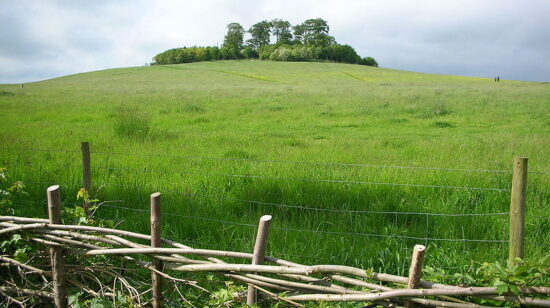
These two impressive hills, which stand proudly at the heart of Earth Trust property beside the Thames in South Oxfordshire, are individually known as Castle Hill and Round Hill.
Collectively, they’re known as the ‘Clumps’, after the clump of beech trees that crown the hills which, dating back at least 300 years, are the oldest known planted hilltop beeches in England.
Historically, they have also been known as Sinodun Hills, the Berkshire Bubs and even Mother Dunch’s Buttocks…!
But these hills aren’t just an environmental marvel, or a natural landmark. They are also ancient sites of human occupation.
The name ‘Sinodun’ is derived from the Celtic for ‘old fort’, and sure enough, the banks of an ancient hillfort are still visible atop Castle Hill.
Starting off as a Bronze Age settlement, people dug a U-shaped ditch around the site, and built up a bank for added protection against marauding enemies. Archaeologists believe that the bank may even have had a palisade on top.
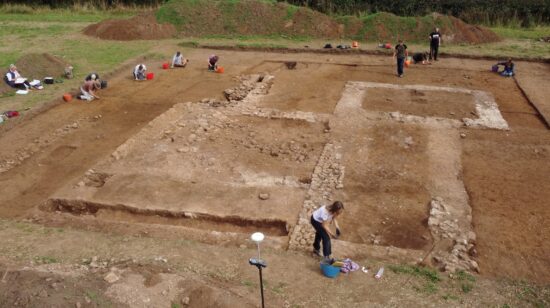
In 2003, an investigation by Time Team focused on the previously unexplored Round Hill. On its slopes, geophysics revealed the remains of a Romano-British house with a mosaic floor, as well as an Iron Age cobbled floor with post holes that may once have been part of another structure or building.
Further investigations found Iron Age rubbish pits distributed all over the valley, suggesting widespread settlement throughout the period, as well as evidence of a Roman road.
Excavations so far indicate that together, the area has been occupied since the Bronze Age around 1000 BC, the hillfort and surrounding farms dating from around 600 BC, followed by a move down towards the southern part of the site around 300 BC.
By the Iron Age, the inhabitants of the Clumps were well settled; they were fishing in the Thames, hunting wild boar from the nearby woods and they also farmed a little. They kept some cattle but mainly sheep, and had started growing wheat and barley. They stored their grain in huge pits to keep it fresh, which enabled them to survive over the winter.
The area was then abandoned, until the construction of the Roman villa. Eventually, Romans settled in the area, and excavations found evidence of at least one Roman building and water storage tanks close to a spring. After the Roman occupation, King Offa of Mercia is said to have built a look-out post at The Clumps after defeating the West Saxons in AD 772.
Many discoveries have also been made incidentally in the area, including an oval bronze shield retrieved from the nearby river Isis in 1836, and the Wittenham Sword and scabbard, found in 1982 and dating from the Late Iron Age (120 BC – AD 43).
Today, The Clumps are the most visited outdoor space in Oxfordshire, and home to the Victorian ‘Poem Tree’, carved by Joseph Tubb with a poem about the landscape and its history between 1844 and 1845. The poem can be read on a commemorative stone marking the 150th anniversary of the carving.
This iconic landmark at the heart of Earth Trust is steeped in history. But that’s just the tip of the iceberg… there’s plenty more waiting to be found.