Round Barrow
Round barrows are circular prehistoric earthen mounds that date from the Late Neolithic to the Late Bronze Age.


Round Barrows are the most common prehistoric monument type in the country with over 10, 000 surviving examples across Britain.
Often, barrows were re-used, with either new burials or cremated remains placed into the sides at a later date. They can be found in isolation but they frequently occur in groups of up to 30. There are many different types, classified based on their form, unique combinations of encircling banks, ditches and level berms. Some of these include: bowl barrows, bell barrows, disc barrows, pond barrows and saucer barrows. Their size can range considerably (usually 6m-20m across, though they can be as wide as 40m in diameter).
Further Reading:
Historic England’s Introductions to Heritage Assets: Prehistoric Barrows and Burial Mounds
What to look for:
- Traces of a surrounding ditch
- Other changes in profile, such as evidence for banks or a berm (the flat area in between a central mound and the ditch in both bell and disc barrows)
- Orientation with other barrows or prominent natural landscape features
- If excavated previously, there are likely to be depressions on top of the mound
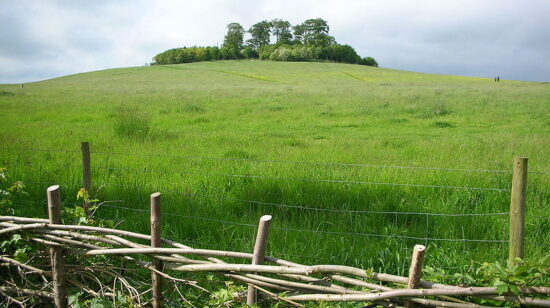
- A small area which is left alone in relation to its surroundings - an uncultivated, often tree-covered hummock in the middle of an open field can indicate a barrow that is already identified and protected