Lime Kiln
A Lime Kiln is the place where limestone material is burned in order to produce lime.




Lime is made by heating limestone (including chalk) to 840-1000°C. It was particularly prized as a component of building materials like mortar and concrete and for land improvement as fertilizer.
The simplest type of Lime Kiln was the ‘clamp kiln’ which involved stacking layers of limestone with fuel and covering them with clay and turf to maintain the heat as they burned. The remains of these type of kilns will be pits up to 2.5m in diameter and up to 2m deep, though they would likely have filled in over time.
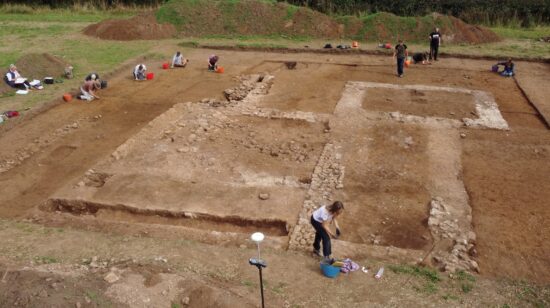
Stone and brick kilns burned more efficiently. These had thick walls with vents at the base to control the burning. Roman kilns usually have 1 flue and medieval kilns generally had two but could have 3 or 4 flues. Similar small-scale kilns were used until the 19th C. The masonry foundations may still be visible today but generally kilns survive as burnt hollows filled with ash and lime.
Kilns are frequently built near to the source of the limestone, or near urban areas where there was demand for lime. They can be found singly but are often clustered for increased production.
Further Reading:
Historic England’s Introductions to Heritage Assets: Pre-industrial Lime Kilns
What to look for:
- Square, rectangular, round, oval, or pear-shaped pits 1-5m in diameter
- Remnants of stone or brick walls
- Soil colour changes due to burning or patches of lime
- Proximity to a limestone or chalk source, possible extraction pits
- Proximity to urban areas