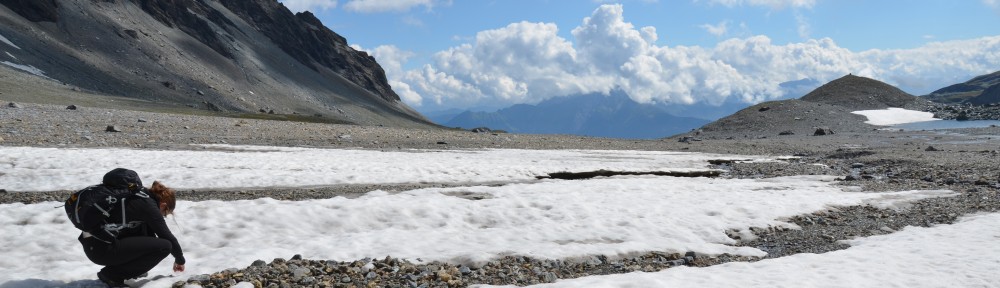
In the Swiss canton of Grabünden, the ice fields are melting. In the grand scheme of things, this is a ‘bad thing’. But for now, it’s good, for archaeologists at least. Except they’re running out of time.
That’s because as they melt, the glaciers and ice patches are revealing some incredible archaeology. The problem is that they are melting at an ever-increasing rate, leaving a rapidly decreasing window of time before they are washed away.
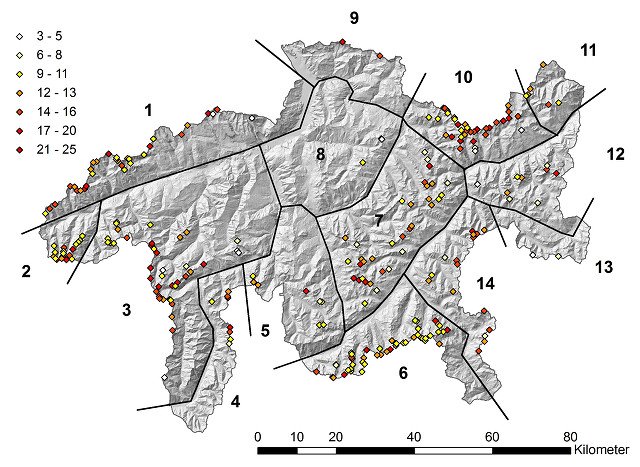
Naef is focusing on narrow Alpine passes 2,500m above sea level that could have been used as trade routes. But that still leaves 260 sites.
So what on earth to do? Faced with a melting glacier, there’s not many who would think to call up the rambler’s association for help. But that’s exactly what a project in Switzerland is doing. Backed up by some mighty fine technology, of course.
The project “kAltes Eis” (or ‘Cold Ice‘) is the brain child of Leandra Naef and brings together an ingenious mix of archaeologists, hikers, alpinists and GIS to systematically scan the melting ice fields for signs of emerging archaeology.
“If we want to do something, it has to happen now, before it is too late, if it’s not already too late” said Naef. Indeed, time is not on the side of archaeologists or the artefacts. Glaciers around the world are ebbing, and Switzerland’s are no exception.
Apart from discovering artefacts, the aim of the project is to identify the most interesting ice patches in the canton so that archaeologists can monitor these sites, but with so many sites, the project is asking ramblers, walkers and hikers to ‘keep their eyes peeled’ for artefacts.

Neolithic shoe found in the alpine ice in between the Bernese Oberland and Valais regions. (KEYSTONE / Canton Bern Archaeological Service)
While nearly a quarter of a century passed since German hikers found the 5,000-year-old corpse of Ötzi emerging from melting ice in South Tyrol, there is plenty of territory to explore in the Alps, according to Naef.
Some of the biggest discoveries in the Alps in recent years include an arrow quiver made from birch bark and leather leggings from around 3,000 BC, which were found by a couple of hikers at the melting glacier in canton Bern Schnidejoch.
DNA analysis revealed that the 5,000-year-old Schnidejoch leggings were not only made of goatskin, but from a breed previously believed to be only common to east Asia.
Discoveries on the Cold Ice project so far include various small nails from shoes, an Iron Age arrow, a brooch and a Roman silver coin. The project continues until December 2015.
“Of course, our greatest hope would be to find a female counterpart to Otzi” says Naef.
So where does the mini exhibition held in a fridge come in? Turns out, it’s probably one of the most important parts of the project. Obviously, a small team of archaeologists could never cover the entirety of the ice fields all by themselves. The involvement of the alpine community is essential.
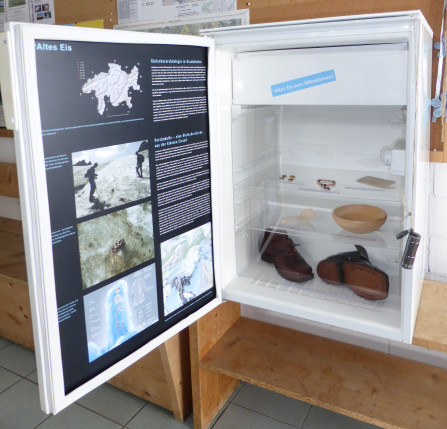
The mini-exhibition on display in a fridge in an Alpine hiking hut. The aim is to ask hikers to ‘keep their eyes peeled’ for artefacts, not just avalanches.
For this purpose, the team has built a small, traveling exhibition to help raise awareness of the project. Small enough to be taken to stations, on trains and even up onto mountain trails these moveable, micro exhibitions are temporarily deposited in hiking huts high up in the Grabünden Alps to gain the public’s attention.
Asked whether she was worried some hikers choose to run off with their finds, Naef said she is not of concerned. She says the uncovered artefacts will likely be wood or other organic items rather than gold coins.
“We are looking for objects did are very valuable for science but whose value for private citizens is difficult to determine,” Naef Explained. “Therefore we do not have to fear looting or grave robbers.”
So if you go for a walk in the Alps next summer, you might just be lucky enough to discover an ancient wonder and save it from the perils of global warming. Pretty cool, huh?
Source: swiss.info and Cold Ice
Archaeology in your inbox?!
Want to join a dig? Learn more about archaeology? Join our email list for a monthly digest of our most popular stories, plus alerts for any digs, events, or courses you can join.
Join the list
Written by Maiya Pina-Dacier
Director of Engagement at DigVentures, Maiya digs with a trowel in one hand, and a Twitter feed in the other. She loves finding new ways to get people involved in archaeology - online and in the field.




There are no comments on this post yet. Be the first!