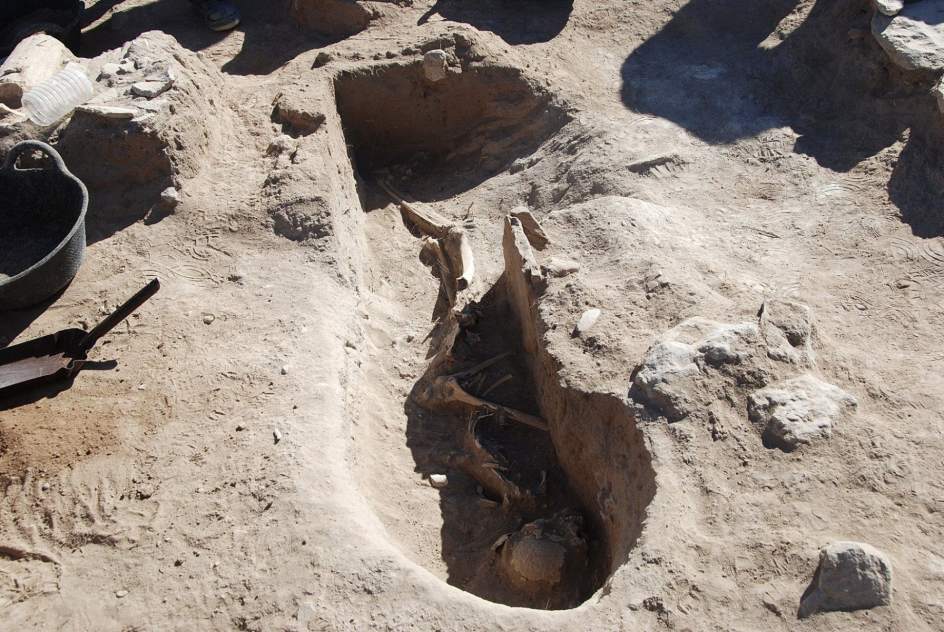
La Mancha, Spain – Researchers have found the buried remains of Spain’s Islamic civilization and a site so full of riches they believe it could take two hundred years to unearth it all.
Located in the high plains of La Mancha, the region characterised by Cervantes as the land of Don Quixote, researchers from University of Castilla-La Mancha have been digging in Piédrola, near the town of Alcazar de San Juan. After just two weeks, the archaeologists say they have discovered what could be one of the most important sites in Spain to date.
An Islamic necropolis over 1,000 years old
Among the finds are Copper and Bronze Age household goods, Roman pottery and traces of Celt-Iberian settlements. But according to project leader Víctor López Menchero, the most exciting discovery is an ancient necropolis containing seven bodies.
Uncovered in a trench just 4 meters squared, the positioning of the bodies — all facing south east towards Mecca — and the lack of accompanying burial items, both suggest that it is a Muslim graveyard.
For López Menchero, the discovery of an Islamic necropolis was a real surprise – few Islamic remains have been discovered in Castilla-La Mancha. Moreover, “the existence of a necropolis, or city of the dead, confirms the existence of a ‘city of the living’ – an Islamic population would have been living nearby at higher altitude” said López Menchero in a statement.
Spain under Moorish rule
Much of Spain was under Islamic rule from the eighth to the thirteenth centuries, with the Alhambra palace in Granada and the Mezquita in Cordoba being the most prominent examples of the Moorish occupation of Spain. In fact, Alcázar de San Juan takes its name from an old Moorish fortress (al-Qassr in arabic), which was later garrisoned by the knight’s of St John.
Moorish Spain was an intellectual melting pot with Muslim, Jewish and Christian scholars exchanging key Greek, Latin and Arabic texts, helping to spark the European Renaissance.
4,000 years of occupation
Other findings have also come to light in the excavations, including a Roman inscription on a piece of pottery, evidence of Bronze Age occupation such as a cheese dish and other utensils, providing rich evidence of each and every civilisation that passed through the region in last 4,000 years.
This suggests that the landscape could be one of the most important sites in Castilla-La Mancha, and even Spain. “We have remains of the Chalcolithic, the Bronze Age, Iberian settlements, a Roman villa, a Muslim farmhouse, the Christian reconquest and the quarry for the millstones which were most important in the region” explained the project director.
A whole world to explore
Victor López Menchero confessed that although it was suspected that they would find remains of great interest, they did not expect to find a cemetery, let alone one in such good condition, given that it is on shallow, arable land occupied to the present day.
“There is a world to explore” said López Menchero “we are not talking about a four-year project: to fully understand everything we’re talking one or two hundred years.”
López Menchero’s archaeological project, jointly run by Castilla-La Mancha University and authorities in Alcázar de San Juan was established in 2013. In the future, they hope to collaborate with the Ministry of Culture to ensure the site of Piédrola can become a major reference for the history and archaeology not only of Alcazar, but the region and the whole of Spain.
Archaeology in your inbox?!
Want to join a dig? Learn more about archaeology? Join our email list for a monthly digest of our most popular stories, plus alerts for any digs, events, or courses you can join.
Join the list
Written by Maiya Pina-Dacier
Director of Engagement at DigVentures, Maiya digs with a trowel in one hand, and a Twitter feed in the other. She loves finding new ways to get people involved in archaeology - online and in the field.




There are no comments on this post yet. Be the first!