Archaeologists in Norway have discovered the burial of a Viking Age woman who was laid to rest with hundreds of miniature pearls, and a rare set of embroidered textiles.
Today we throw away clothes and buy new ones without thinking twice, but in Viking times it would take a full person-year of working hours to making enough textiles to clothe a family.
As valuable as they were, finding such clothes, last worn over 1,000 years ago, is so incredibly rare that archaeologists in Norway could hardly believe their luck when they discovered the burial of a Viking Age woman laid to rest with embroided wool fabric preserved on top of a turtle brooch, and hundreds of miniature pearls.
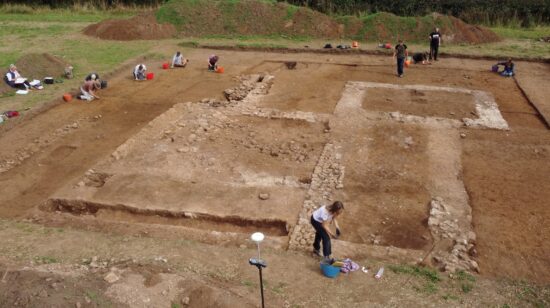
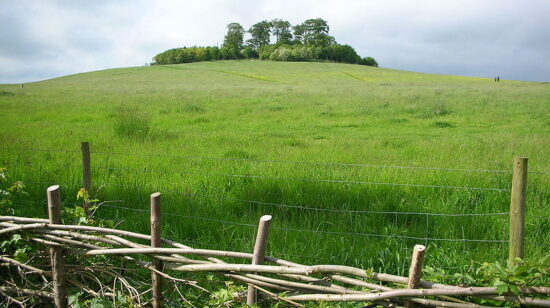
The deceased woman was found placed in a wooden burial chamber in an elongated burial mound at Hestnes in southern Trøndelag county, and has been dated to approximately AD 850-950, in the middle of the Viking Age.
“The pearls were concentrated over her right shoulder, but we don’t know if they were a pearl necklace or something else. A find from Hedeby with similar pearls has been interpreted as being pearl embroidery in one form or another, and it’s plausible that the same is the case here,” says Raymond Sauvage, archaeologist and project manager for the excavation.

Overview of the burial layout. Illustration: NTNU University Museum

Numerous and varied textile tools accompanied the woman into the grave, including these wool combs. The artefacts may indicate that she worked in the manufacture of textiles. Photo: NTNU University Museum
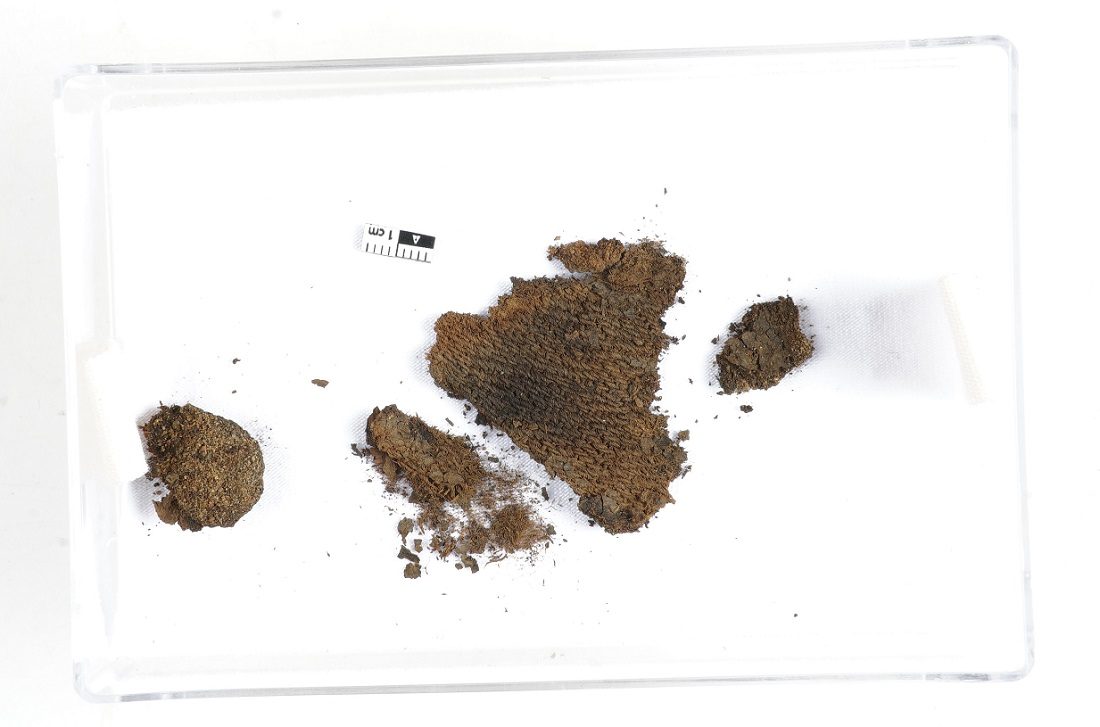
The wool fabric is of the type called diamond twill, and has a pattern reminiscent of that found in jeans. The fibres in this fragment are so well preserved that archaeologists hope to make isotope analyses of it. Photo: NTNU University Museum
“We imagine that the woman was wearing a pinafore dress, which was fastened with turtle brooches. Under the dress she probably had on a sark or shirt of linen or fine wool. Over her shoulders she was likely wearing a cape with embroidered decorative elements,” says Ruth Iren Øien at the NTNU University Museum.
In some places, they found textiles layered on top of each other, including where the needles attach to the brooches, which they believe represent garments from both inner and outer clothing.
“The cape appears to have been lined with a fine wool fabric and along the edge we can see remnants of narrow braiding. This braid might have been made to strengthen the edge, but it also had a decorative function” says Øien.
Finding well preserved textiles is incredibly rare, and it is even more unusual to find embroidered textiles, which are known only from a few opulent graves, like Oseberg and Mammengraven in Denmark.
Several of the fragments reveal information about the stitching and details used for assorted types of clothing and, although it can be difficult to figure out which dyes were used, the team of archaeologists say they are keen to take a closer look at the colours of the clothes.





Comments (3)
This was an amazing article! I absolutely loved this, the history that can be learned from these finds is astounding! I definitely enjoyed the read!
Awesome article.
Proofread. Dyes. Not dies lol
Fantastic! I’m amazed at the amount of information that was gathered from these finds and anyone can picture how this woman looked in life from the descriptions .