The impressive settlement is the likely home of people who built and used one of the most iconic prehistoric monuments in Oxfordshire.
Archaeologists from DigVentures have unearthed the remains of an extensive Iron Age settlement with the remains of at least 15 roundhouses dating from 400BC to 100BC, as well as a large Roman villa built over the abandoned iron age homes in the late third to early fourth century.
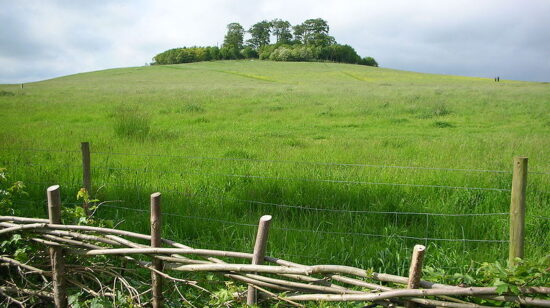
Both lie in the protective shadow of Wittenham Clumps – the site of an Iron Age hillfort on the banks of the River Thames. Today, the hillfort is cared for by environmental learning charity Earth Trust. Located 15 miles south of Oxford, and 50 miles west of London, it is one of Oxfordshire’s most iconic prehistoric monuments, and on a clear day it’s possible to see the equally iconic Uffington White Horse.
Exactly where the people who used this hillfort actually lived had remained uncertain, but the team believes the question has now finally been answered.
So far, the excavation has revealed the remains of at least 15 circular roundhouses, and the discoveries provide a glimpse inside the lives and homes of the community who used the hillfort over 2,500 years ago.
The houses range in size from 8m to 15m in diameter, but the majority are around 10m in diameter and provide a living area of at least 78 m², which is more than the living space of the average UK home built since 2010.

One of the fifteen roundhouses visible as a dark brown circle in the ground, with slots excavated by the archaeologists

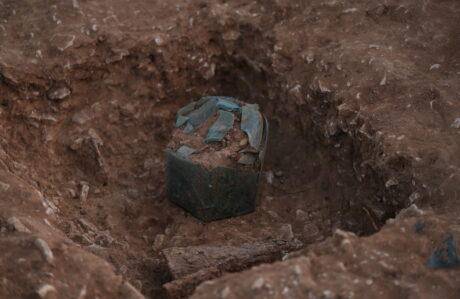
Archaeologists Indie Jago and Josh Hogue with two of the Iron Age food jars (photo taken before February 2020)

Archaeologist Ben Swaine shows of the size of the largest roundhouse, with the hillfort in the background

Aerial view of the hillfort, with the River Thames on the left
Evidence from the dig, which was carried out ahead of improvements to the Earth Trust visitor centre, will be used to reconstruct part of an Iron Age village on the site.
Among the remains, the team excavated what has been nicknamed an Iron Age ‘fridge’ or pantry – a collection of ceramic food storage vessels which would have been kept cool and safe within a pit dug into the ground.
A fragment of daub which appears to have been painted was also found, which suggests that rather than simply being mud-coloured, the walls of the roundhouses may have been decorated.
“Given how close we are to the hillfort, it’s not surprising that there’s a settlement here – it’s the sheer scale of it that’s impressive” said Chris Casswell, Head of Fieldwork at DigVentures.
“We weren’t expecting to find so many houses within such a small space – the area we’ve excavated is just over a hectare and the settlement itself is clearly much larger. We’ve still only uncovered one corner of it. What’s surprising is that hardly any of it showed up on the initial geophysics survey, probably due to a quirk in the local geology. It was only when we started digging that we were able to reveal the true extent of what is here” he said.
The excavations, which have been live-blogged since they began in 2018 and which come to an end this week, have revealed the clear outlines of the houses, including ‘drip gullies’ which kept them dry much like a modern gutter, as well as the postholes where the upright beams supporting the roof would been installed.
Starting on Tuesday, people (including families) will be able to learn more about the discoveries and interact with the archaeologists who unearthed them through a series of free, live online events.
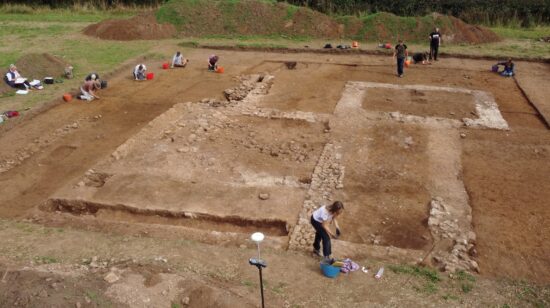
The dig has also revealed the footprint of a large Roman villa, built on the site of the abandoned roundhouses.
Measuring 30m long, and with at least 7 column bases, it appears to be a ‘winged corridor villa’ and would have been home to a wealthy family with a working farmstead.

Footprint of the villa outlined in recent snowfall
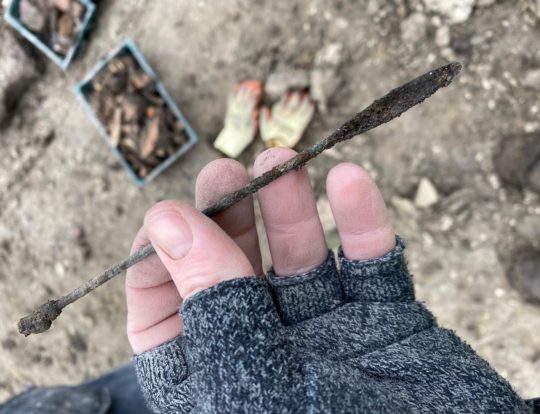
A medical spatula probe was among the finds

The finds also included Roman kitchen utensils, including a strainer, ladle, knife, cooking pots, and tableware

Archaeologist Indie Jago takes photos of the excavated corn dryer
Among the Roman remains, the team has unearthed all sorts of artefacts left by the inhabitants, including cooking utensils like strainers, spoons, knives, a ladle, cooking pots, and tableware, as well as some prized possesions such as a surgical spatula probe that would have been used for applying ointments and oils to wounds, and some delicate, but well-preserved bone combs.
There’s also a corn dryer, used for drying corn after harvest. Charred cereal remains were found inside, as well as in some of the Iron Age pits, which show that people were growing wheat and barley throughout the Roman and Iron Age periods.
“It’s everything you’d expect to find at a busy settlement, but that’s what’s so exciting about it – these are the foods, homes, and artefacts that made up the everyday reality of these people’s lives” said Casswell.
The villa itself survives only as a footprint, and was completely stripped of all building materials in the past, to be re-used in new buildings elsewhere. Alongside the villa, there are about 42 graves. Most of the burials appear to be Roman.
“We think we might be looking at a site that was continuously occupied from the middle Iron Age, all the way through the Roman period, but there could also be signs of a brief hiatus. We won’t know for sure until we’ve had a closer look at all of the available dating evidence, but we’re very excited to find out the answer” he said.
The excavation is being carried out on behalf of Earth Trust – the environmental learning charity who look after many of Oxfordshire’s most popular green spaces, including the Wittenham Clumps.
DigVentures and Earth Trust have teamed up to create a series of free, interactive online events taking place between 16 February – 09 March.
Themed around the idea of home, the events will provide families and adults with a chance to learn more about the discoveries, and life in the past, directly from the archaeologists.
“With so many people being confined to their homes, we’re really excited to be able to provide a glimpse of what ancient homes were like. People will be able to find out what was happening along the River Thames in Oxfordshire during the Iron Age and Roman periods, and learn more about their homes – based on the evidence we’ve uncovered” said Lisa Westcott Wilkins, co-founder of DigVentures.
Earth Trust are also currently working on designs to reconstruct a roundhouse based on the archaeological discoveries, in order to preserve and share the story of the site.
“Although previous digs by Time Team and Oxford Archaeology close to the site had already revealed the first few signs that something might be here over a decade ago, we are lucky that we are now able to complete that story, reveal the true extent of what was going on here, and share some of the excitement with people at home” she said.





Comments (3)
In South Africa ancient settlements are identified in exactly the same way: as they too were thatched dungn’daub roundhouses.But then, the surrounding contemporary villages are STILL constructed this way. It rather…expands?…disrupts?…causes a shift? in the way one thinks about time. Or at least about how much of it there’s been.
Hi this is hugely of interest but more so when the dig is finished and plans evolve to build three Iron age round houses.
The reason I ask about this is because I am the Explorer Scout Leader of Incendium ESU Wallingford. They are 14 – 17 year old and I love to get the unit involved some how? I this is possible please get in touch.
Kindeat regards Sandy Taylor
Can we see the geophysics results report that failed to identify the newly found archaeology at Wittenham Clumps?
Cheers!