 It’s often said that if we don’t learn the lessons of the past, we’re doomed to repeat them in the future. That’s been a running theme in British politics this week, as the coalition government have brought forward a scheme called ‘Help to Buy,’ which according to David Cameron, will make “the dream of home ownership a reality.”
But other voices in the Government have raised concern that these State backed mortgages (available on properties up to the value of £600,000 to anyone with a 5% deposit) will not so much help people “put down roots and start a family” as fuel another housing bubble based on second homes and buy to let.
Sound like history repeating itself?
 It probably does to Professor Stephen Shennan, current Director of the UCL Institute of Archaeology, whose statistical work on population studies in the Neolithic (published by Nature this week) suggests that we’re not only repeating the mistakes of the last 8 years, but the mistakes of the last 8000!
The Neolithic could be called our first ever ‘housing boom,’ with a graduation form a largely mobile lifeway based on hunting and gathering to sedentary and housebound farming communities. The first evidence for agriculture can be found in Turkey from approximately 8,500 years ago. France followed next with evidence from about 7,800 years ago, with Britain, Ireland and Northern Europe coming in at the rear at approximately 6,000 years ago.
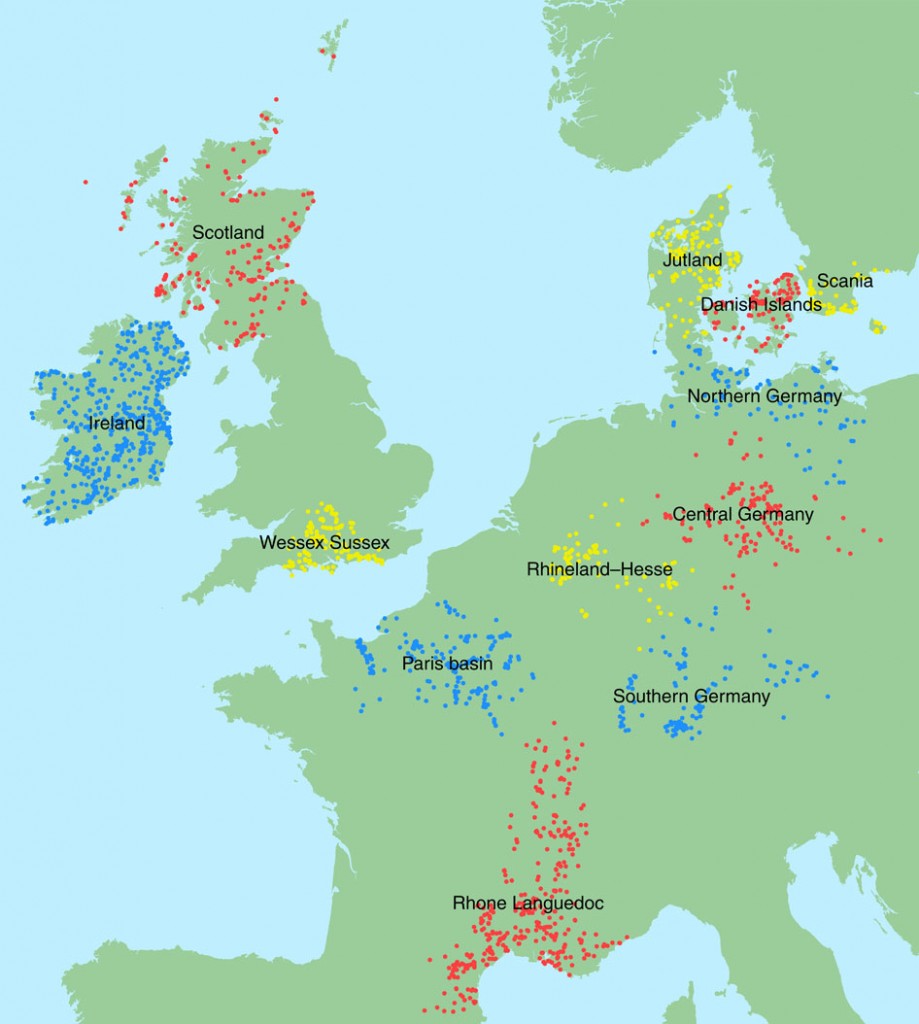 However, new studies have led some academics to believe the development and spread of agriculture may have caused a roller coaster effect for these Neolithic communities, with population numbers soaring to record peaks, before plunging to extreme depths.
Stephan Shennan and his team used almost 8,000 radiocarbon dates from sites across Western Europe to calculate population levels before and after the introduction of farming. His findings suggest that ten out of the twelve regions which developed early farming were also subject to extreme population fluctuations, based on the assumption that the more sites a region has, the more people there were living there. He says farming was followed by a double dip in population size – with two large booms each followed by a significant fall. He also suggests in these areas there was as much as a 30-60% decline in population compared to their peaks, a decline which he describes as of similar consequence to the decline in these regions caused by the Black Death.
Sean Downey from the University of Maryland in College Park gives a possible explanation for this pattern, suggesting that decline may have been due to ‘diminishing natural resources.’ Population growth in Britain would have caused a reduction in the number of forests, ultimately leaving less wood and less food than was needed to sustain a large population.
However, not all academics are convinced by Shennan’s argument. Jean-Pierre Bocquet-Appel comments on the Science News website that although the procedures used in the study are valuable, his interpretation is that there are actually only three regions which display clear statistical evidence for these kinds of patterns; Ireland, Scotland and Southern France.
Overall, very little is still known about the population trends of early European populations, and this debate is likely to continue on the pages of Nature.
As they say in Estate Agents up and down the land: You pays your money (and you takes your choice!).
Archaeology in your inbox?!
Want to join a dig? Learn more about archaeology? Join our email list for a monthly digest of our most popular stories, plus alerts for any digs, events, or courses you can join.
Join the list
Written by Aisling Serrant
An all round museum educator and enthusiast, Aisling's the Family Festival Coordinator at the Museum of London Docklands.




There are no comments on this post yet. Be the first!