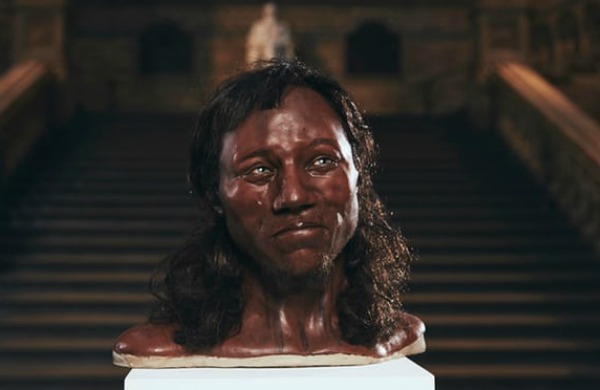
Archaeologists already knew Cheddar Man was about five foot five inches tall, around 10 stone with good teeth and that he died in his early 20s. But recent advances in genetic sequencing techniques have now allowed them to determine the colour of his eyes, skin and hair.
The information was passed to Dutch ‘Paleo-artists’ Alfons and Adrie Kennis, who make facial reconstructions of extinct mammals and early humans.
A previous reconstruction of Cheddar Man, made by the University of Manchester before DNA tests were available, depicted him with white skin. With the new results, the Kennis brothers were able to produce a more accurate likeness.
Professor Ian Barnes, a geneticist, who worked on the investigation said ‘I assume [this is] going to be a big surprise to most members of the public.’
Dr Rick Schulting, an archaeology professor at Oxford University said: ‘It may be that we may have to rethink some of our notions of what it is to be British, what we expect a Briton to look like at this time.’
The findings add to evidence that pale skin emerged much later in Europe than most people realise; it wasn’t until the advent of farming, less than 8,000 years ago, when people were obtaining less vitamin D though dietary sources like oily fish. And those changes themselves were brought by mass migrations from the near East.
The gene variants for paler skin are mutations brought to Europe less than 8,000 years ago from mass migration from the near East.
Prior to that, evidence suggests darker skin was dominant here ever since humans first arrived to Europe from Africa some ~40,000 years ago. (2/3)
— James Wong (@Botanygeek) February 7, 2018
There are multiple genetic variants linked to loss of pigmentation, including some that are very widespread in European populations today. Cheddar Man had ‘ancestral’ versions of all these genes, which is what strongly suggests he, like other Mesolithic Europeans, had dark skin.
Dr Yoan Dieckmann, from University College London, who also took part in the project, said: “The historical perspective that you get just tells you that things change, things are in flux, and what may seem as a cemented truth that people who feel British should have white skin through time is not at all something that is an immutable truth”.
The results will be revealed when The First Brit: Secrets of the 10,000 Year Old Man airs on Channel 4 on Sunday February 18.






Comments (3)
Not really surprising, considering the darker skin tone of the sami population in scandinavia and the inuits. Both grpups have maintained a lifestyle closer to the pre-historic hunter-gatherer populations.
I was under the impression blue eyes came from Greece/turkey around 5000bc????? Due to a mutation????? This story outdates that by 3000 years??? Or has that much changed in DNA testing??? Also black skin???? I doubt very much he was black as a African,I’m sure he was tanned but if he was black surely most of Europe would still be black???? I think this story has a lot of faults
How lovely, a link to our ancestral African past.