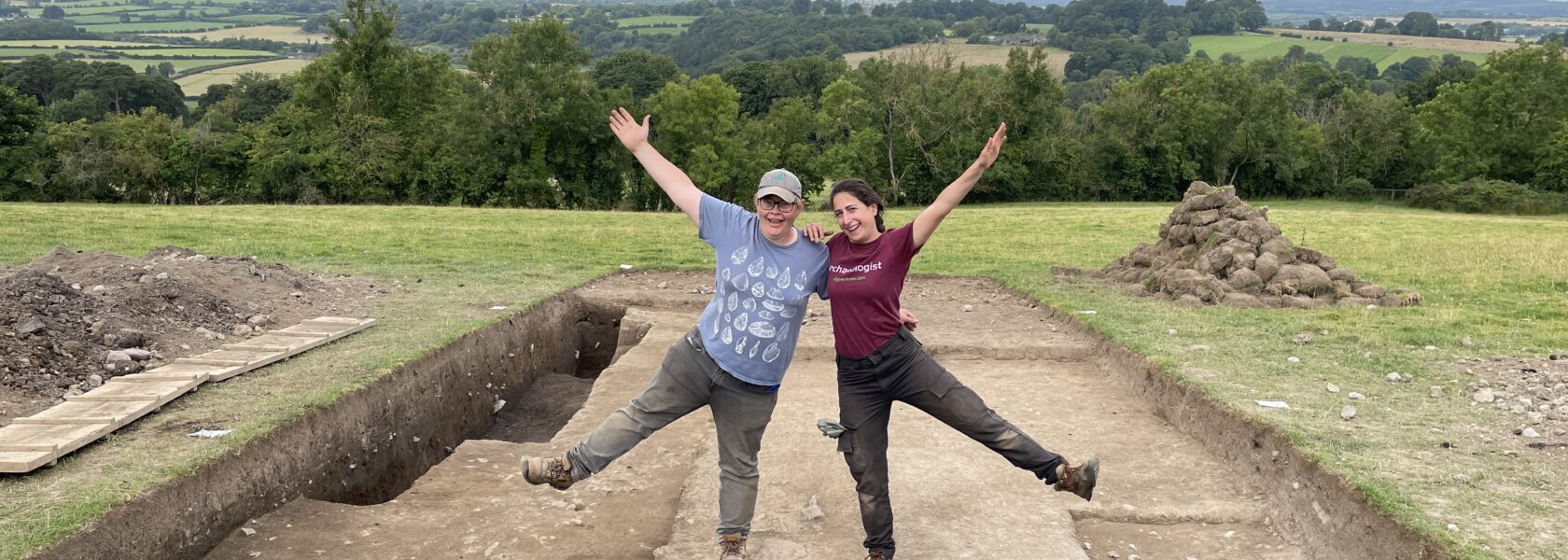

The results are in: Radiocarbon dates from the Boyne Valley are totally Neolithic!
Thanks to our crowdfunders, we sent four samples from our dig in the Boyne Valley for radiocarbon dating. Now, the results are back from the lab and they’re fascinating!
The Brú na Bóinne World Heritage Site in the County Meath, Republic of Ireland, is home to some of the most iconic Neolithic monuments in the world, including sites like the passage tombs at Newgrange, Knowth, and Dowth. Built between 6000-4000 years ago, and decorated with megalithic art or perfectly aligned to light up on solstice or equinox, these monuments are feats of ancient engineering.
But they are not alone. Our crowdfunded dig just a few kilometers to the south has revealed another cluster of ancient monuments. Why did people build them? Why here? And where do they sit on the timeline in relation to the other famous megastructures of the Boyne Valle?
Understanding the chronology of these sites is absolutely fundamental to understanding the evolution of the wider Brú na Bóinne landscape.
While pottery, tools, and other artefacts can give us a broad or relative date range, radiocarbon dating is one of the most powerful tools we can use to narrow down the dates with an absolute date range – which is especially important when you’re talking about such ancient sites.
Thanks to our crowdfunders, we were able to send four carefully selected samples from this season’s excavation to the radiocarbon dating lab for analysis. Now, the results are in!
Let’s take a look:
Sample 1: The causeway ditch (14C93-11)


Geophysical survey revealed the footprint of a vast, circular monument, which our excavation confirms was made of ditches dug deep into the ground. But when were these ditches dug? And how old is the monument compared to the others? We collected a sample from the bottom of the ditch section we dug in 2024 and sent it for radiocarbon dating to find out…
The result: Cal 3720 – 3630 BC (Early Neolithic)


Radiocarbon dating confirms that this monument was in use during the Early Neolithic. This is when causewayed enclosures begin to appear elsewhere in Britain and Ireland, and also coincides with the arrival of farming.
It’s only the third known example of a causewayed enclosure in Ireland, and the dating evidence we have so far makes it slightly younger than the other two known examples at Magheraboy (4100 BC – 3800 BC) and Donegore (4000 BC – 2700 BC).
But these monuments are so large, so rare, and sometimes stayed in use for so long that we will need to radiocarbon date more samples from other parts of the monument before we can truly begin to understand its age or compare it to others
Sample 2: The buried bowl (14C93-10)


When the dig revealed a hefty chunk ofn ancient pot buried inside the monument, the excitement rippled across site; this was one of only a handful of artefacts that could help us date the monument. The fabric was coarse, but well-fired – typical of prehistoric pottery dating to the Bronze Age. But when our pottery specialist, Elaine, examined it she thought it looked much older than that. Based on comparable examples from nearby sites, she identified it as a carinated bowl that had likely been made during to the Early Neolithic (4,000-2,500 BC). Was she right? Luckily, the bowl was buried in a charcoal-rich deposit and we were able to send a sample of this deposit for radiocarbon dating.
The result: Cal 3660 – 3520 BC (Early Neolithic)


Radiocarbon dating confirms that Elaine is correct! Not only is this bowl much older than we had first thought, these dates suggest that it was buried while the monument was in the prime of its Neolithic life, rather than during a period of later Bronze Age re-use.
Sample 3: The charcoal pit (14C93-09)

Alongside the causewayed enclosure, excavation revealed an ovoid pit full of rich, dark charcoal. Could this be another feature related to the early Neolithic monument? Perhaps the remains of a feast? A funeral? Or something else entirely? We sent a sample for radiocarbon dating to find out…
The result: Cal 1800 – 1930 AD (Modern)


These radiocarbon dates took us completely by surprise! This charcoal pit had roused a lot of curiosity, and although there had been some speculation that it could be more recent – perhaps even medieval – no one expected it would be this recent and less than 100 years old. It shows just how important radiocarbon dating can be for helping archaeologists to unpick a site…
Sample 4: The ceremonial avenue posthole (14C93-12)


Geophysical survey revealed the footprint of a ‘ceremonial avenue’, which our excavation confirms was lined on either side by thick wooden posts planted deep into the ground. But when was it constructed? We sent a charcoal-rich sample from the bottom of one of these postholes for radiocarbon dating.
The result: Cal 2630-2460 BC (Late Neolithic – Early Bronze Age)


Radiocarbon dating confirms that this monument is as old as many other monuments in the Boyne Valley, and may even be contemporary with sites like Dowth Henge. Analysis also revealed that the charcoal was made from hazel, a strong and flexible wood often used for crafting tools, household items, and fences.
So what next?
Radiocarbon dating has the potential to transform our understanding of the past, allowing us to build reliable chronologies of everything from monument-building to the spread of technologies and cultural practices. Radiocarbon dates can even lead to major revisions of previously accepted timelines.
Just thinking about the implications of these results gives us goosebumps. But as impressive as they are on their own, we’re going to need many more radiocarbon dates before we can form a detailed and nuanced story about these monuments and where they fit in relation to all of the other monuments across Brú na Bóinne.
Now that we’ve got a glimpse of how old these monuments are, even bigger questions emerge.
Which monuments are they contemporary with? And which ones do they predate? Were they built all in one go, modified, maintained, and expanded over generations? How long were they in use for? When were they abandoned? And were they ever re-discovered and re-purposed by communities later down the line?
Your support is crucial for telling the story of Ireland’s Neolithic origins…