 The route taken across the Alps by Hannibal and his army in 218BC has been hotly debated for centuries, but now the potential discovery of a mass deposit of horse dung could be about to reveal all.
It’s one of history’s most infamous feats, a 30,000 strong army, including 15,000 horses and over 30 (pretty chilly) elephants, riding over the Alps to launch an attack on the heart of Rome. Hannibal’s invasion of Italy formed an early part of the Second Punic Wars, which saw the Roman Republic and Carthaginian Empire fight it out over territory in the western Mediterranean.
The mystery
The crossing, and initial victory for Hannibal and his army over the Roman forces, has been immortalised through myth, literature and art for centuries, but despite the immense fame of his military operation, the exact path that Hannibal took has, incredibly, remained an enigma. That is, until now…
A team of international scientists led by geomorphologist Bill Mahaney of York University, Toronto and microbiologist Chris Allen of Queen’s University, Belfast, think they might have just cracked it.
A ‘mass deposit’
By studying evidence gleaned from the writings of Roman historians Polybius (200-118BC) and Livy (59BC-AD17) they were able to identify a high pass in the Alps, known as Col de la Traversette, which closely matched both historians’ accounts of the terrain. This treacherous pass is located between a row of peaks on the border to the south-east of Grenoble in France and south-west of Turin in Italy.
Using a combination of environmental chemistry and microbial genetic analysis, they studied organic remains from a large pond in the area, which could potentially have provided a water source for Hannibal’s army on their crossing. They were excited to discover a mass deposit of animal faecal materials, likely to be from horses, which can be directly dated to around 200BC.
Everything comes down to poo

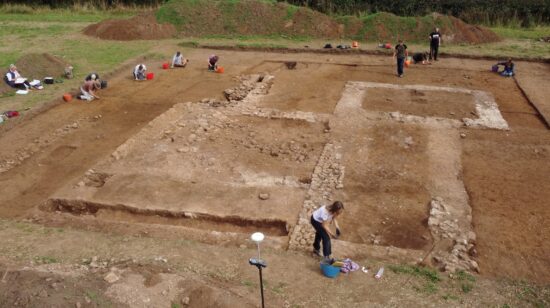
Aerial photo of the expedition site – Peeter Somelar, University of Tartuu (Estonia)
If it can be undeniably proved that this layer of ancient poo does come from horses, or even humans, then this find could be an exciting break through, potentially putting an end to centuries of debate and speculation about Hannibal’s route.
The study of ancient faeces or coprolites (fossilized dung) is a hugely important tool for archaeologists, as it can help answer so many questions about past people and their environment – see Why Having Viking Ancestry Could Be Bad For Your Health.
But there’s still some work to do
Exciting as this find is, the scientist still need to find conclusive evidence that this faecal deposit does indeed come from horses. As the sample contains a high number of Clostridia microbes, which are known to make up over 70% of the microbe groups in horse dung, the results are promising. But for now researchers can only speculate that this indicates the presence of horses.
Further analysis and genetic sequences is needed to make this a conclusion a certainty. The scientists even hope to find the eggs of parasites, like gut tapeworms, amongst the deposit, which could shed light on the presence of horses, men, and even Hannibal’s elephants.
A discovery of huge potential
The range of information that could be gathered from this enormous stool sample is huge, if animal species is successfully identified, then more can be learnt about animal’s upbringing and geographic origin, and could even provide clues on just how they survived this epic march across the Alps.
H/T The Conversation
Archaeology in your inbox?!
Want to join a dig? Learn more about archaeology? Join our email list for a monthly digest of our most popular stories, plus alerts for any digs, events, or courses you can join.
Join the list
Written by Rosanna Ring
Rosanna is one of DigVentures' intrepid Community Archaeologists. She's busy turning Barrowed Time (our dig at Morecambe's Bronze Age burial mound) into a real seaside adventure, and getting the Pop-Up Museum on the Prom ready for you to visit!