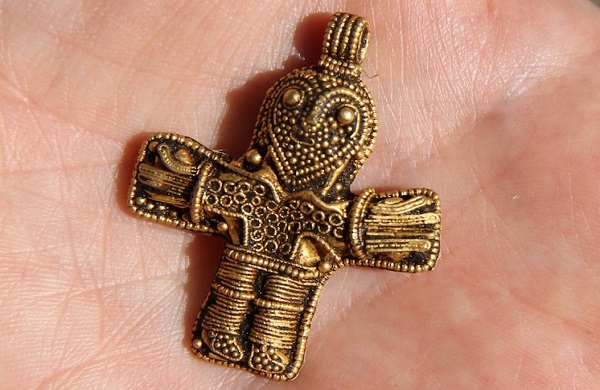
This stunning gold crucifix is the earliest to be found in Denmark, potentially pushing back the date for when the Danes became Christian by almost half a century.
When metal detecting enthusiast and amateur archaeologist Dennis Fabricius Holm set out to survey a field outside the small village of Aunslev on the isle of Funen, Denmark, little did he know that he was about to unearth an incredible find…
The detectorist discovered a small gold pendent depicting Christ on a crucifix, and quickly reported it to an archaeologist at Østfyns Museum. Dating back over 1,100 years to the first half of the 10th century AD, it predates the oldest known depiction by almost half a century.
The crucifix is just over 4cm high, and crafted out of filigree gold pellets and gold thread. Due to its delicate appearance, archaeologists think it was likely to have been worn by a wealthy Viking woman, though they have yet to decide whether it was intended to show her status as a Christian, or whether she wore it as a souvenir of an ‘exotic’ foreign land.
Bluetooth and Christianity
King Harald Bluetooth is widely believed to have converted the Danes to Christianity in AD965, an act that is documented on a famous rune stone found in the town of Jelling in central Denmark.
On the stone Harald boasts of conquering Denmark and Norway and bringing Christianity to the Danes:
‘King Harald ordered this monument made in memory of Gorm, his father, and in memory of Thyrvé, his mother; that Harald who won for himself all of Denmark and Norway and made the Danes Christian.’
Incidentally, it’s also thought that modern Bluetooth technology is named after Harald due to his strong communicative skills in bringing the warring factions together!

Harald’s Rune Stone from Jelling, Denmark
Challenging belief
According to archaeologist and curator of Østfyns Museum, Malene Refshauge Beck, the discovery of the gold crucifix potentially challenges the rune’s accepted date for when Christianity entered the region.
‘Over the last few years there have been more and more signs that Christianity was spread earlier than previously thought – and up until now, this find is the clearest proof of that.’
Previously, fragmented silver crucifixes have been found in female Viking burials in Denmark, but none had dated as early as this one from the early 10th century AD.
Raiders and traders
In recent times it’s become increasingly more apparent that, as well as being vicious raiders, the Vikings also created strong trade relationships with the places they visited: exchanging ideas and beliefs as well as material goods. The trade networks that they established would have introduced them to Christian beliefs as early as the 8th century AD, making it entirely possible that the conversion of Viking Denmark started earlier and as a more gradual process.
Though the discovery of this crucifix alone isn’t enough to prove this theory, the questions that it has already raised will be enough to spark the hunt for further evidence.
And there’s more…
The find is also a very positive example of what can be achieved when archaeologists and metal detectorists work hand-in-hand, and it’s important that this relationship continues to be strengthened in order to make more exciting discoveries like this one.
It’s amazing the power that one small find can have in order to shake up our accepted ideas and theories about the past. With every archaeological find there’s always the potential to uncover the next game-changing piece of evidence to challenge everything that we thought we knew about our history.
It’s one of the joys of this profession!
H/T: LiveScience
Archaeology in your inbox?!
Want to join a dig? Learn more about archaeology? Join our email list for a monthly digest of our most popular stories, plus alerts for any digs, events, or courses you can join.
Join the list
Written by Rosanna Ring
Rosanna is one of DigVentures' intrepid Community Archaeologists. She's busy turning Barrowed Time (our dig at Morecambe's Bronze Age burial mound) into a real seaside adventure, and getting the Pop-Up Museum on the Prom ready for you to visit!