This was one very lucky man.
Ouch! The story of an Iron Age warrior who lived to tell the tale after receiving an arrow wound directly to the spine.
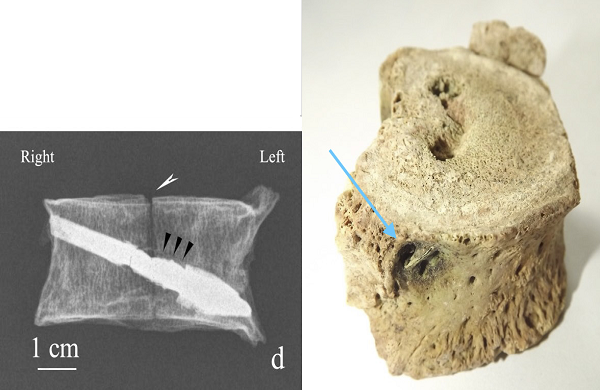
When archaeologists studying the remains of a Scythian warrior from a burial in Kazakhstan found an arrowhead lodged in his spine, they might have thought they’d identified the cause of his death. Incredibly though, the vertebra appeared to have healed in part around the arrowhead, indicating that he did in fact survive!
Why it hadn’t lead to death
In most cases a piercing wound like this would almost certainly have meant death; if the initial injury didn’t kill the victim, then the ensuing infection would often finish the job. Incredibly, in this man’s case, the arrow appears to have missed all the main blood vessels in the spine and lodged itself into the bone.
In another stroke of luck for the warrior, analysis of the arrowhead’s metallic composition revealed that it had a high tin content, rather than lead, which was also a commonly used material. A lead arrow left lodged in the body would ultimately have resulted in a long and drawn out death from lead poisoning. This guy was extremely fortunate to have survived!
Battle wounds
CT scans of the bone revealed that the arrowhead was triangular in cross-section. By comparing the arrow with other early Iron Age arrowheads discovered in Europe, the archaeologists have identified it as military, suggesting that he received the injury in battle.
[Read more: This medieval knight died from jousting injuries].
Based on the positioning of the arrow the archaeologists even think they’ve determined the direction that the arrow had been fired from. The angle suggests that the arrow flew at him from above and from the right, indicating his assailant was on higher ground.
The man behind the injury
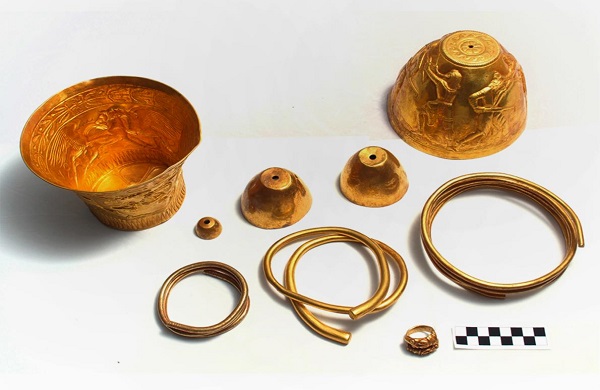
Scythian gold
Standing at an impressive 5ft 7in, the warrior would have been tall compared to his fellow community, whose average height would have been around 5ft 4in. Aged between 25-45 at the time of his death, he was buried in an impressive burial mound (or ‘Kurgan’,) suggesting he was a member of the Scythian aristocracy.
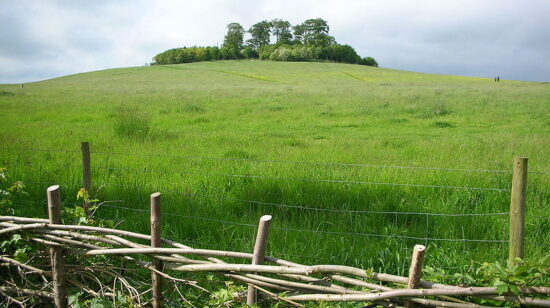
The Scythians were a powerful group of fierce nomads who lived on the central Eurasian steppes from the 900 BC to 200 AD, wreaking havoc on the surrounding Greek and Persian populations. Little evidence of their existence survives today, with the exception of the grand Kurgans dotted amongst the landscape and references to them in the writings of the Greek historian Herodotus.
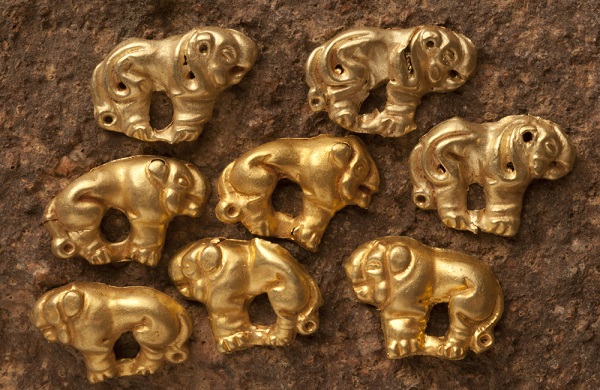
And some more Scythian gold. Beautiful stuff.
Now, excavations of the Kurgans in Kazakhstan and Russia have started to shed more light on this little understood community. Spectacular golden artefacts depicting highly detailed images of the Scythian warriors, their clothing and weaponry have been found, giving the briefest of glimpses into their society.
The violent scenes illustrated on the artefacts hint at the warring culture of the tribes, and could reveal how this particular warrior received his injury.
The resilience of the human body
The archer probably shot the arrow from higher ground.
Whether he received the wound warring with fellow Scythian tribes or with local Greek or Persian populations remains unknown, but judging from the design of the arrowhead and what is known about the aggressive nature of the Scythian tribes, it may be safe to assume that he received this wound in battle.
How long he survived, and the quality of his life afterward, are also unknowns, but the fact that he survived long enough for the bone to heal is an amazing testament to what the human body can withstand and recover from without access to the medical treatments available to us today.
Archaeology not only teaches us about the past, but can help us to understand more about ourselves and the amazing things of which the human body is capable.
Archaeology in your inbox?!
Want to join a dig? Learn more about archaeology? Join our email list for a monthly digest of our most popular stories, plus alerts for any digs, events, or courses you can join.
Join the list
Written by Rosanna Ring
Rosanna is one of DigVentures' intrepid Community Archaeologists. She's busy turning Barrowed Time (our dig at Morecambe's Bronze Age burial mound) into a real seaside adventure, and getting the Pop-Up Museum on the Prom ready for you to visit!