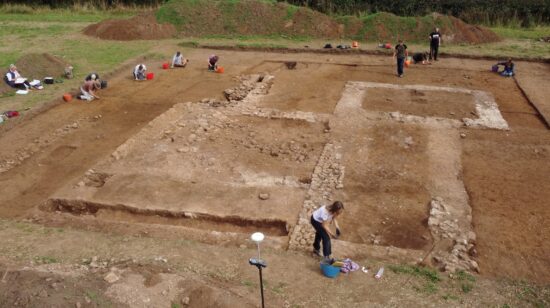
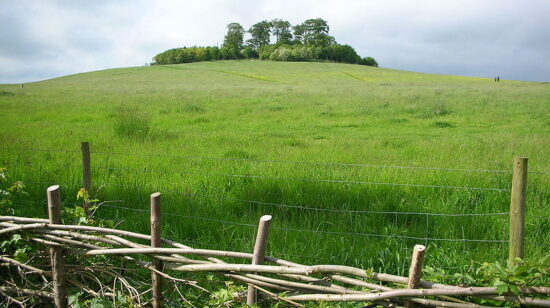
Source // Fulvio314, via Wikimedia Commons
The ability to date whatever you like, wherever you like, is the archaeologist’s dream. And it looks like a new carbon-dating technique is about to help make that dream come true.
It seems that DigVentures weren’t the only ones promoting groundbreaking innovation last week. A new radio carbon dating technique looks set to join Digital Dig Team as one of the biggest tech innovations set to revolutionise field archaeology this year.
Developed by the University of Liverpool, the new technique uses a Quadrupole Mass Spectrometer, which will reduce the time it takes to get carbon-dating results from a number of weeks to just a couple of days. Even better than that, it can be used on site without needing to send samples away.
The science
Carbon dating determines the age of archaeological objects, or how long ago a creature died, by measuring the amount of Carbon -14 remaining inside. The method is based on the theory that every living organism contains a small but constant proportion of this radioactive carbon isotope.
When the organism dies the C-14 is no longer replaced and that which remains decays at a constant rate. The time it takes for one half of a radioactive isotope to decay is known as its ‘half-life. By knowing the half-life of C-14 and estimating how many C-14 atoms the organism contained before it died, we can calculate the age of an object or creature at time of death.
Radio-carbon dating can only be effectively used on materials which once formed part of a living organism, which means that materials such as stone and metal can’t usually be directly dated in this way.
Current techniques used for carbon dating, such as Accelerator Mass Spectrometry, can be expensive processes and require samples to be sent away for analysis, typically taking 6 weeks or more for information to be relayed back.
Initial tests
Trials on samples provided by Norton Priory Museum & Gardens have been carried out, and the results when compared to traditional carbon dating methods are said to have produced “encouraging levels of agreement” – this suggests that they’re perhaps not QUITE there yet, but are nonetheless close enough to attract significant interest.
[Read more: C is for Carbon Dating]
The university’s Department of Electrical Engineering & Electronics has received funding from Arts Council England to develop this technique as a portable device, and appear confident that their attempts will be a success. They currently anticipate the first unit will be available to field archaeology staff for trials as soon as 2016!
An exciting innovation
Like our own Digital Dig Team (which enables archaeologists to upload discoveries in 3D straight from the trenches), this new technique could transform the way field archaeologists work. The time involved and expense of taking samples would be dramatically reduced, meaning that more samples can be taken, and theoretically, more can be learned from each site.
Potentially, archaeologists could receive results within days of taking a sample, which could have a huge impact on the way a site is interpreted, as well as help to direct the next phase of excavation.
It’s a hugely exciting prospect, and a development DigVentures will be following with great interest!
Archaeology in your inbox?!
Want to join a dig? Learn more about archaeology? Join our email list for a monthly digest of our most popular stories, plus alerts for any digs, events, or courses you can join.
Join the list
Written by Rosanna Ring
Rosanna is one of DigVentures' intrepid Community Archaeologists. She's busy turning Barrowed Time (our dig at Morecambe's Bronze Age burial mound) into a real seaside adventure, and getting the Pop-Up Museum on the Prom ready for you to visit!