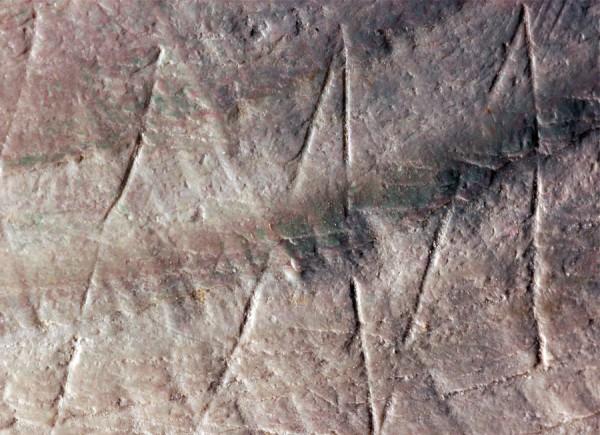
A zigzag engraving made on a shell half a million years ago may transform scientific understanding of what has long been considered one of the defining traits of modern humans: artistic creativity.
These days, we’re all familiar with entering a gallery, looking at something on the wall and thinking “yes, but is this really art?” Even so, art is generally seen as a uniquely human trait, and the manufacture of geometric engravings is generally interpreted as indicative of modern cognition and behaviour.
A zigzag found on a shell from Indonesia is the world’s oldest example found by archaeologists to date. What’s remarkable is that is was made 500,000 years ago, not by modern humans, but by our ancestor Homo erectus.
Until now, the earliest known example of geometric art was thought to have been etched into ochre in South Africa around 70,000-100,000 years ago, the start of Homo sapiens’ unique cognitive journey into a sophisticated world of abstraction and symbol.
But this is the first evidence that Homo erectus – who emerged around 2 million years ago and disappeared 140,000 years ago and are generally thought to be an ancestor to both modern humans and Neanderthals – were capable of such mental agility.
Secrets of the Shells
The engraved shell was originally unearthed in 1891 by Dutch paleoanthropologist Eugène Dubois, along with the first specimen of a Homo erectus fossil. It sat in a museum in Leiden, the Netherlands, for over a century and remained unrecogonised until archaeologist Josephine Joordens noticed it while studying the collection when researching how Homo erectus used marine resources.
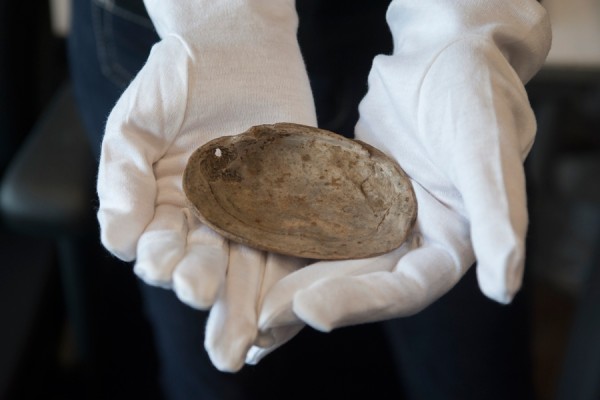 At first, she simply thought the marks had been made when some tool-using Homo erectus opened the shell, but on closer inspection under a microscope, a visiting colleague noticed that there were no gaps between the turns, suggesting the markings may have been made intentionally, and with care.
But is it art?
After dating the shell to between 430,000 and 540,000 years old, the team experimented to recreate the markings and found it was surprisingly difficult. “In the end we are really certain that this must have been made by an agent who did a very deliberate action with a very sharp implement,” said Joordens in an interview with Nature.
However, without knowing the engravers intention, it is difficult to call it art. And yet… it is a pattern. It could have been just a doodle, it could have been made to mark property. But if it had been found among Homo sapiens fossils, we probably wouldn’t hesitate to say it was some sort of early or symbolic artform.
Profound implications for the human story
In their Nature paper, Joordens’s group does avoid using terms like art, symbolism, and modernity. Nevertheless, it’s a discovery with profound implications. It’s generally thought that humans became anatomically and behaviorally modern between 100,00 and 200,000 years ago, with the full flowering of our ostensibly unique artistic capabilities evident by 40,000 years ago.
We know that Neanderthals may also have possessed a rich symbolic culture, but theirs was relatively recent. Earlier this year, we reported the “naughts and crosses” engraved into a cave in Gibraltar inhabited by Neanderthals. This was the first such marking we know of that seems to have been made by another human species.
But add a geometric pattern-making H. erectus and that really does start to challenge the usual narrative of human uniqueness. What we think of as typically modern human behavior clearly didn’t appear in a quick and sudden flash of evolutionary inspiration.
“The origin of such cognition, such abilities,” said archaeologist Josephine Joordens, “is much further back in time than we thought.” Indeed, the very notion of modern humans as being so cognitively unique is now “up for reconsideration,” said Joordens.
What constitutes art and how uniquely human it is will probably continue to be argued about for years to come. In the meantime, we’re off to glare at some stuff in a gallery. Or maybe enjoy this video of Josie the chimp and her multi-coloured paintings.
Source: Nature and Nature Letters
et al. Nature http://dx.doi.org/10.1038/nature13962 (2014).
Archaeology in your inbox?!
Want to join a dig? Learn more about archaeology? Join our email list for a monthly digest of our most popular stories, plus alerts for any digs, events, or courses you can join.
Join the list
Written by Maiya Pina-Dacier
Director of Engagement at DigVentures, Maiya digs with a trowel in one hand, and a Twitter feed in the other. She loves finding new ways to get people involved in archaeology - online and in the field.






Comments (3)
Isn’t that title a little embarrassing from an archaeology site?
Embarrassing? Unless you mean you think the title is badly worded, the discovery that Homo erectus made art before Homo sapiens is deeply fascinating, with all sorts of implications for our understanding of the evolution of human cognition. Nothing to be embarassed about there, but a source of much information and a whole new area of our ancestors’ behaviour for archaeologists and palaeoanthropologists to explore!
Of course I think the title is badly worded! Humans are not limited to Homo Sapiens. It’s a title I expect from the Daily Mail or Express.