Options for Sustainable Archaeological Archives
Learn more about the latest in a series of research projects investigating some of the existing issues that are associated with archaeological archives.
Options for Archives
Exploring options for archaeological archives
The success of development-led archaeology since the early 1990s has led to a major increase in the quantity of archaeological material in museum stores across the country and many museums are becoming unable to accept new finds.
The Options for Archives project is the latest in a series of research projects investigating some of the existing issues that are associated with archaeological archives. The 21st Century Challenges in Archaeology report, undertaken by CIfA and Historic England, reported the sector wide consensus that new repositories for archaeological archives were needed at a national or regional scale.
Last year DigVentures, working with the Cambridge County Council Historic Environment Team and Sam Paul Heritage, undertook an assessment of strategic options for storing archaeological archives. The study was funded by Historic England and Arts Council England and involved wide sector consultation. You can find the outcome of that project and the recommendations made in the report here.
A National Collection of Archaeological Archives
Recommendations aimed to facilitate access to heritage and maximise public benefit from archaeology – a key need identified from previous work and from consultation activities. Importantly, the Options for Archives research suggested that the solution needed to look beyond capacity and encompass accessibility and public benefit. To secure a sustainable future for archaeological archives, the project proposed the creation of a National Collection of Archaeological Archives (NCAA) which would provide:
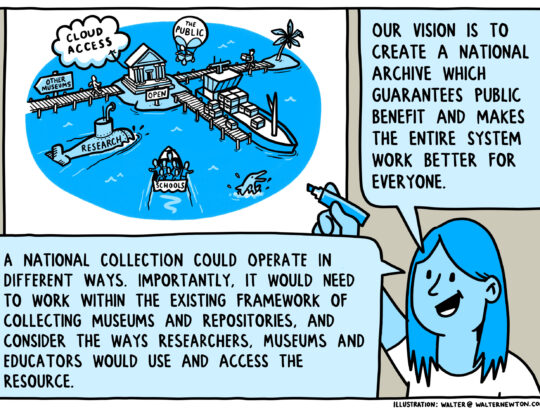
A national, sustainable archaeological archive which guarantees public benefit through being discoverable and accessible, facilitating new stories of our shared past through the continuing use and reuse of resources created by archaeological processes, equally accessible to researchers, educators, curators and the public and providing a seamless interface between data, archive materials, organisations, and communities.
The proposed NCAA provides a long-term solution for archives which currently are not depositable due to lack of capacity in local museums and a network which includes existing repositories wishing to retain and collect archaeological materials in their regions. Key components of the NCAA could include a single online catalogue, a set of standards for preparation, deposition, curation and access, and a Collections Policy which links the NCAA to national and regional research frameworks.
Although this recommendation is yet to be fully explored, the recommendation for a NCAA has been welcomed by Historic England and Arts Council England, and next steps are being investigated within Historic England’s Future for Archaeological Archives Programme.
Finding the right model
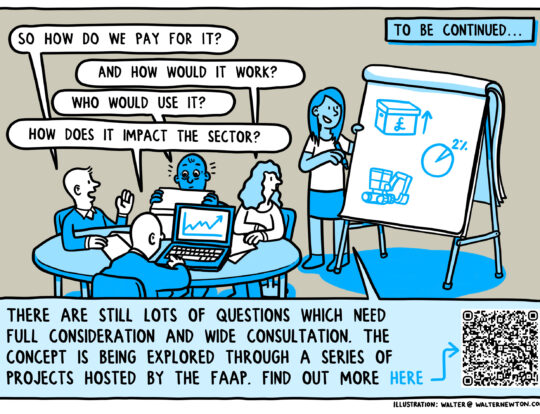
A key piece of the puzzle has been exploring different cost models able to support the proposed NCAA and secure a sustainable future for archaeological archives. In 2023, the project team entered a new stage, funded by Historic England, to explore how different deposition fees could fund long-term curation of archives. The aim of this project was to inform the development of a charging system that is fair, proportionate and easily understood. Most recently, from 2024, we’ll be looking at operational models and how they might impact how users and audiences will get the best from the Collection.
The project team is led by Sam Paul Heritage and DigVentures, working with Cambridge County Council. Sector consultation will inform our round up of the project and – importantly – a series of recommendations made to Historic England for discussion within the scope of the Future for Archaeological Archives Programme.
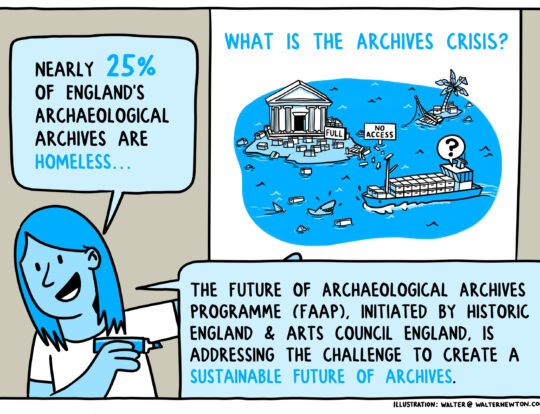
This infographic by Walter Newton provides a little more info what the project is investigating…

Want to know more?
The current project kicked off in January 2024 and the team will be working on the data collation, consultation and analysis over three months. Our report will summarise the results of the data collection and sector consultation, providing recommendations to the FAAP about the development of the national collection.
If you want to know more, just get in touch with the project team via Manda Forster (manda@digventures.com).