
Have I Just Found a Stone Tool? How to Tell if Your “Worked Stone” Is the Real Deal
Stone tools are among the most insightful links to our prehistoric past. Pick up a piece of worked flint, and you’re holding something someone shaped with their own hands thousands of years ago. Each tool was designed for a specific purpose, so effective that the techniques for making them endured hundreds of thousands of years. Every ripple, notch and scar is testament to the time, energy and care put into making them.
But how can you be sure that what you’ve found is a tool, and not just a bit of broken stone that looks like one?


Left to right: Ripple-flake blade, Egypt (3300 -3200 BCE). Credit: Iry-Hor, Wikimedia Commons. Palaeolithic handaxe, Britain, 550,000-300,000 years ago. Credit: DigVentures. Neolithic arrowhead, Ireland. Credit: DigVentures.
Some stone tools are instantly recognisable. A beautiful ripple-flaked knife, a symmetrical hand axe or a skilfully serrated arrowhead leave no doubt that they were shaped by human hands. But what about the more everyday tools? To the untrained eye, scrapers, flakes and simple blades can look like…well, just broken stones. And sometimes, naturally broken stones can look a lot like human-made stone tools, too. Tricky!
Fortunately, there are key markers we can look out for that help to differentiate human-made tools from naturally broken stone. Whether you’re on a dig, out fieldwalking or digging in your back garden, here are the four key things to look for…
First things first: Knapping


A flint core found in Moorsholm, North Yorkshire. Credit: DigVentures
It helps to know a bit about how tools are actually made before you start looking for the tell-tale signs of a tool. The process is called “knapping”, and it involves a few different elements:
Flint: A fine-grained sedimentary rock that’s ideal for knapping because it breaks in a somewhat predictable way, creating sharp edges that would’ve been perfect for cutting and slicing. It was often the material of choice for prehistoric toolmakers across Europe, Britain and Ireland, but there’s evidence of other stone like obsidian and quartz being used, too.
Core: A big chunk of stone (often flint) that, when struck with another stone, produces flakes. The flakes can be formed into tools, or the core itself can be shaped into a tool.
Hammerstone: The stone (or sometimes antler) used to strike the core to make flakes. Hammerstones are usually a type of resilient stone that won’t fracture when knocked against the core.
Flake: A thin piece of stone, removed from the core by the hammerstone.
Four things to check to see if you have a stone tool on your hands
1. Look for the striking platform


The striking platform is a big clue that a piece of stone has been modified by humans. When a hammerstone strikes a core to knock off a smaller piece of stone (a flake), it needs a flat surface to work from – and that’s the striking platform. Striking platforms can be naturally occurring, or deliberately prepared by the toolmaker. Either way, that flat surface ensures the force travels through the core at the right angle, to produce clean, even flakes. You can often see that flat surface at the base of flakes, letting you know you likely have a human-made tool.
2. Next up, the bulb of percussion

On the smooth inner face of the flake, just below the striking platform, you should be able to see a small round bulge, known as the bulb of percussion. This bulb is the result of the shockwave created when the hammerstone strikes the core. The energy radiates out and causes the stone to fracture and bulge, and this is one of the most reliable indicators of human modification, because naturally broken stone rarely produces this result.
3. Can you spot any ripples?

Radiating out from the bulb of percussion, you should be able to see what looks like ripples on a pond. These ripples are the visual record of how the energy travelled through the stone at the point of impact. They are sometimes very subtle, especially on weathered stone. Ripples can be easier to feel than to see, so run your thumb down the smooth side of the flake until you can feel them.
4. Finally, retouches

Retouching is the process of taking a flake and carefully refining the edges to shape it into a specific tool, or to re-sharpen a blunted tool. This is done by applying localised, controlled pressure along the very edge of the flake, or by doing small, precise strikes, removing very tiny flakes. The result is usually a scalloped or a serrated edge (kind of like a bread knife!). Tools can be re-sharpened many times, and a repeatedly sharpened tool can end up much smaller than when it was first made.
What can stone tools tell us?
Once you’ve identified a stone tool, it can reveal a lot – not just about the object itself, but about the people who made and used it.
Palaeolithic tools (3.3 million years ago to ca. 12,000 years ago) tend to be larger, hand-sized and more roughly worked – like chunky hand axes and large flake scrapers. Moving into the Mesolithic (10,000 – 4,000 BCE) and Neolithic (4,000 – 2,200 BCE in Britain), tools become progressively smaller and more specialised, with microliths, awls and carefully crafted arrowheads reflecting greater technical skill, and a more diverse toolkit to adapt to different environments and ways of life.
These significant style changes can give archaeologists clues about age, but only to a point, as stone sticks round! Stone tools are non-organic, which means they don’t decay over time, like other artefacts. In fact, it’s not uncommon to find prehistoric flints on Roman or medieval sites. They may have been picked up as curiosities, reused or simply churned up from earlier layers, during farming or building.


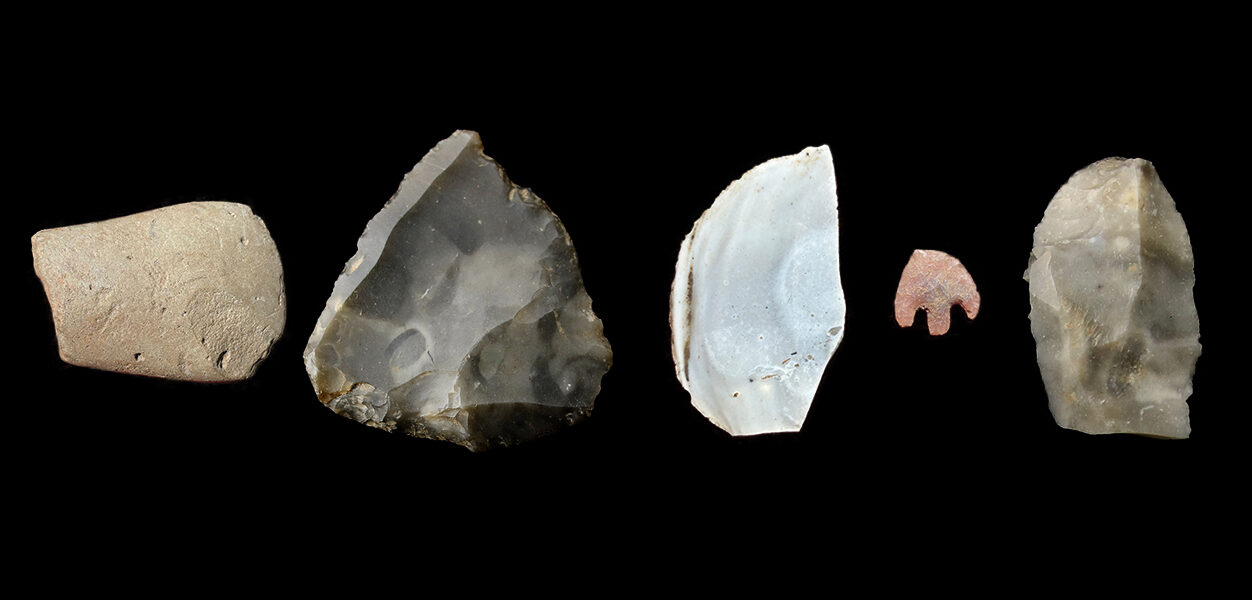
A collection of flint tools found at our early medieval site at Lindisfarne. Credit: DigVentures
Beyond dating, the tools themselves offer direct evidence of how people lived. Microscopic residue analysis can reveal what a tool was used on (like animal fat or plant fibre) and a tool’s shape and edges can tell us what it was used for. A thicker scraper edge suggests hide-working, while a fine, thin blade points to cutting softer materials.
But sometimes, tools weren’t practical at all, and can tell us about a past community’s worldview. The quartz tools recovered from our Boyne Valley excavation in Ireland, for instance, may have been ritual or ceremonial in nature. Quartz is a material that holds deep symbolic significance in the prehistoric landscape of the region, but it doesn’t lend itself as a practical tool material. These objects suggest that the people who made them were thinking symbolically, investing meaning into the materials they worked with.
Prehistoric stone tools connect us to people who lived, worked and thought in ways that are both familiar and almost entirely alien to us today. Next time you spot a promising piece of stone, take a moment to trace its ripples, study its edges, and consider what life might’ve been like for the last person to hold it in the palm of their hand thousands of years ago.