

With 2025 marking the tenth and final year of our fieldwork at Lindisfarne, we’ve been reflecting on some of our favourite moments from Holy Island, alongside the incredible discoveries made across all of this year’s sites.
None of them would’ve been possible without the support, enthusiasm and sharp-eyed curiosity of our wonderful community of Venturers, who’ve been with us at every scrape of the trowel, both on site and online. This year, over 3,000 adults and children from 50+ countries joined us to get actively involved, both online or in the field.
So, without further ado, let’s take a look at just a small selection from a truly memorable year!
1. Catherine’s Roman glass


Credit: DigVentures
Catherine joined us for a full week at Earth Trust in May, and quickly became something of a finds magnet! In archaeology, you never know exactly what’s around the corner (or what’s going to emerge in the next trench) and Catherine certainly proved this. She helped excavate evidence of an archway that may have been an entrance to the Roman building, reveal the remains of a column base, and recover important fragments of pottery that expand our understanding of the site.
But the best moment was when Catherine found this gorgeous shard of iridescent Roman glass, recognisable from its blue tinge and bubbly surface. Small and shimmering, it’s mighty and moving in the much bigger story it hints at – and we love finds like this that bring us closer to the daily rhythms of life in Oxfordshire nearly two millennia ago.
2. Nils’ flint blade

Credit: DigVentures
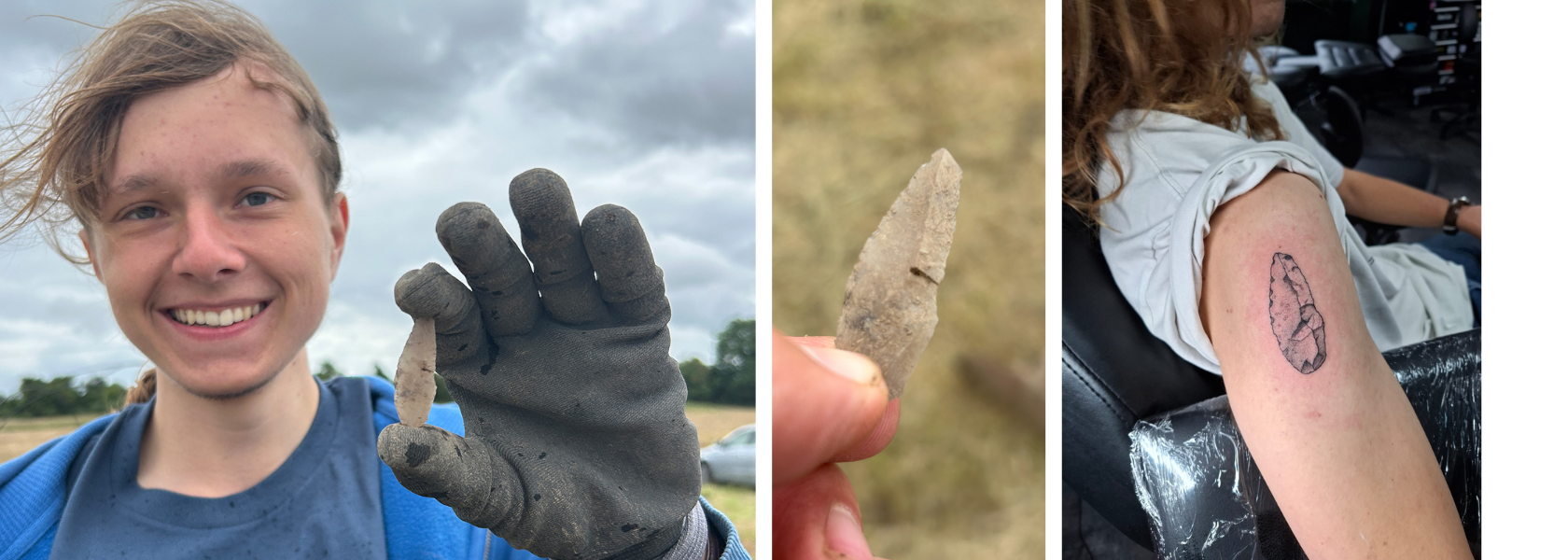
During what began as a routine session of topsoil sieving at our Boyne Valley dig in July, Nils spotted something pretty extraordinary – a complete, undamaged flint blade, a small but crucial tool of the Neolithic period when people were farming, crafting and shaping their world by hand.
As his very first artefact find, it made such an impression that, after some keen-eyed sketching by DV’s own Jonski, Nils went on to have the blade immortalised as a tattoo.
(And to Nils’ parents, if this is how you’re finding out…we’re sorry.)
3. Ayden’s gaming counter, hinting at play through the centuries


Credit: DigVentures
During DigClub in East Yorkshire this August, Ayden uncovered a small, round glass token that we think may be a Roman gaming counter.
As well as showing that fun and play have been around for centuries, it’s a brilliant reminder that real archaeology is open to all ages, and that you don’t need years of experience to uncover something amazing. We especially love it when our younger Venturers make finds like this. We know how powerful these moments can be, often leaving an impression that brings them back to site years later!
We’re also fairly sure Ayden’s lucky t-shirt set him up for success that day…
4. Bill strikes gold (or, rather, stone) with two namestones


Credit: DigVentures
We’ve been incredibly lucky to have long-time Venturer Bill digging with us since 2018, and in that time Bill has made a number of exciting discoveries, including human remains, early medieval clues and even prehistoric flint.
This year, however, Bill’s early medieval chickens well and truly came home to roost during our last year of digging on Lindisfarne, where Bill found not one but two namestone fragments, just hours apart. We still get a shiver when we think back to the very first namestone we discovered on the island in 2016, and each new fragment feels just as special.
Bill’s larger piece is particularly striking, with traces of inscription still visible alongside a neat border and curved motif. Together, these details offer a rare glimpse into the identities, lives and beliefs of people living in early medieval Northumbria.
5. Gulfareen’s moment of connection across time, with her early medieval burial


Venturers Cathy, Chris and Gulfareen. Credit: DigVentures
After a considerable break from the field, archaeologist Gulfareen wasn’t sure she’d be able to return to digging this year, but she managed to join us for our final season on Lindisfarne, and we’re so glad she did! It was also her first time working with human remains, an experience she’d always wanted to have since training in archaeology.
The individual in the shroud burial she uncovered was laid to rest facing east, and Gulfareen shared that this echoed the direction Muslims face when praying towards Mecca, creating a moment of personal and meaningful connection.