

Community archaeologists unearth lost Saxon cemetery and evidence of Bronze Age rituals in the Quantock Hills
The Quantock Hills might be known to many as ‘the place where Jez and Mark get lost’, but this National Park was also England’s first designated Area of Outstanding Natural Beauty.
Now, community archaeology is also demonstrating that the importance of the picturesque Quantock Hills goes much deeper than the surface level (literally): buried in its soil, there is evidence of life, death, and ritual activity spanning over 1,500 from the Late Bronze Age all the way through to the Early Medieval.
Mysterious cropmarks

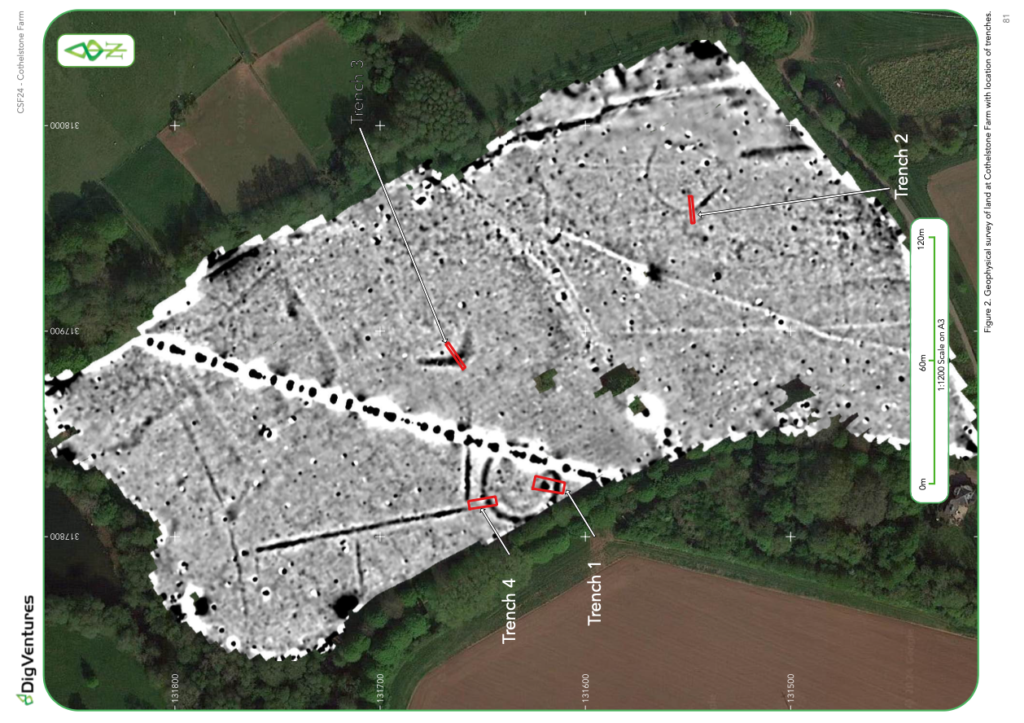
Geophysical survey of Cothelstone Farm with trench locations (DigVentures)
Aerial photographs revealed a series of mysterious cropmarks prompting archaeologists to ask question: could these be the remains of a previously unknown ancient settlement? If so, who lived here? When? And what were their lives like?
When geophysical survey confirmed the presence of a 35m diameter circular feature, DigVentures was commissioned by the Quantocks Landscape Partnership Scheme (QLPS) to investigate the origins of these mysterious features with a community dig.
We welcomed 108 local residents who signed up to join the excavation, and together we set to work on our investigation.
Bronze Age ceremonies (1200-800 BC)

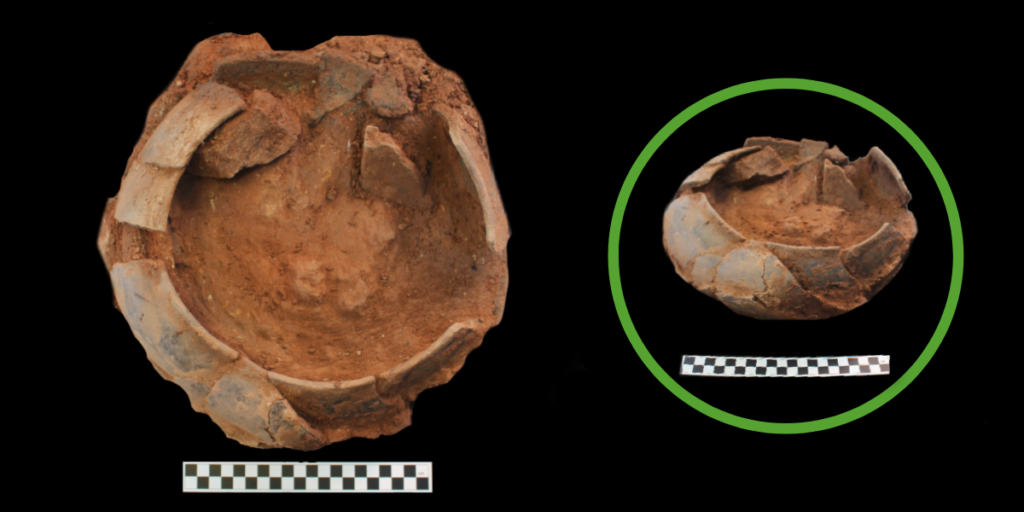
One of three Late Bronze Age pot found at Cothelstone Farm, during micro-excavation (DigVentures)
Excavation revealed a type of ancient monumental earthwork known as a ring ditch, marked by a 1.5m deep ditch. Ring ditches are circular ditches which usually date to the Neolithic or Bronze Age. In some cases, they surrounded roundhouses or barrows. In others, they were built as enclosures for livestock, settlement boundaries or as a marker for ceremonial spaces.
someone had buried three Late Bronze Age pots.
These pots were remarkably well preserved and had clearly been placed there deliberately.
They were surrounded by traces of charcoal and sparse animal bone remains, potentially the remains of a feast. Radiocarbon dating later revealed them to be around 3,000 – 2,800 years old.
But why were they buried here?
“Although we can’t know exactly why these three pots were buried, we think they were probably placed as part of a celebration, perhaps marking the construction of the ring ditch itself. This would also explain the potential feast remains surrounding the deposit and gives us a window into the rituals and celebrations of Bronze Age inhabitants and marks the first ceremonial use of this landscape for generations to come” said DigVentures Lead Archaeologist Ben Swain.
The three pots were later ‘micro-excavated’ by specialists in the lab to see whether they contained any organic materials that might tell us more. Inside, they found tiny, burned food remains that tell quite the story. Charred wheat and oat grains were found, alongside hazelnut shells, revealing some of what Bronze Age people may have been cooking at eating here.
Additionally, burnt wood pieces found during micro-excavation were equalling revealing. From analysis, we can see that the Bronze Age inhabitants were gathering firewood from a diverse local forest – collecting hazel, poplar, willow, oak, ash, birch and elder. Even more interesting, was the presence of small, round hazel twigs and branches suggest they were carefully selecting the perfect kindling for their fires. Some pieces might even have come from old woven structures (wattle) that had served their purpose and found new life in the flames.

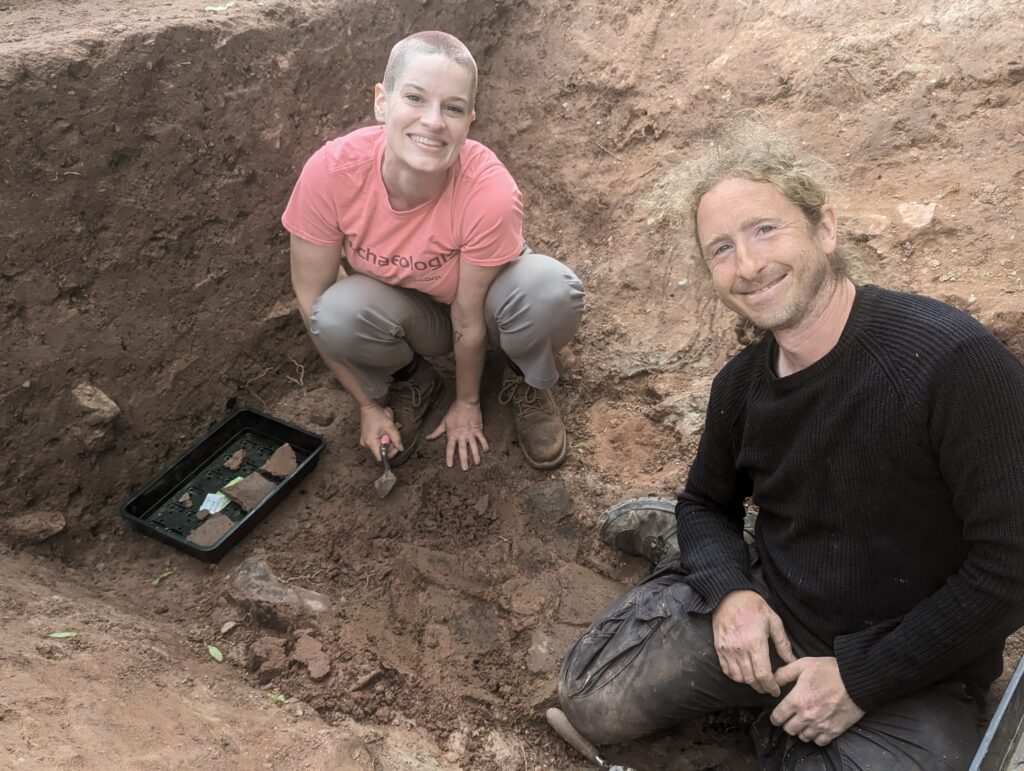
Anna and Ant carefully excavate and lift the Late Bronze Age pots (DigVentures)
Iron Age inhabitants take over (8th – 6th centuries BC)
These Bronze Age pots were just the beginning of this ancient site.
Excavation showed that the huge circular ditch was cleaned out and re-dug several centuries later, in the Early or Middle Iron Age.
During the dig, local residents discovered domestic artefacts, including a ceramic spindle whorl used in weaving.
“From what we can see, people were living at the site seasonally, leaving evidence of domestic life such as food and tools,” said Ben.
Eventually, after the Middle Iron Age, the site is temporarily abandoned. However, it’s not long before this impressive ancient monument called to a new community…
Iron knives, Roman jars, and early medieval burials (400-500 AD)

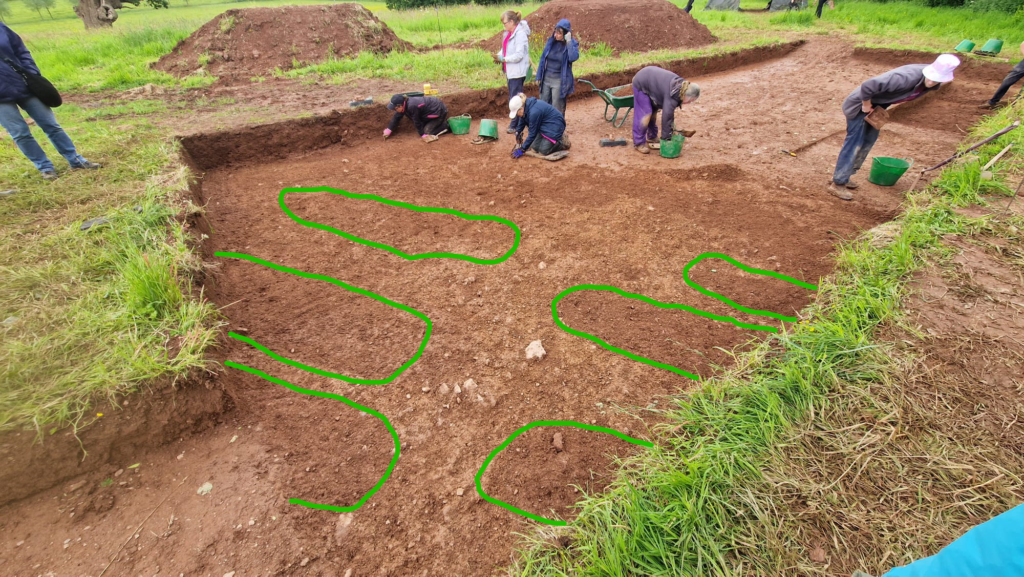
Grave cuts discovered at Cothelstone Farm, highlighted (DigVentures)
Over a thousand years later, the location caught the attention of a new community who decided to use it as a cemetery.
Together, archaeologists and local residents uncovered 13 graves. Although the skeletons hadn’t survived, discoveries included three iron knives found, as well as two Late Roman jars dating to 200-400 AD.
“Without organic material for radiocarbon dating, we can’t quite tell whether the cemetery is Late Roman, Anglo-Saxon, or a bit of both. What we do know is that Anglo-Saxon people did sometimes re-use Roman pottery and even bury people with it. It’s fascinating to think that these people might have held onto ‘vintage’ items – just like we do today’’ said Ben.
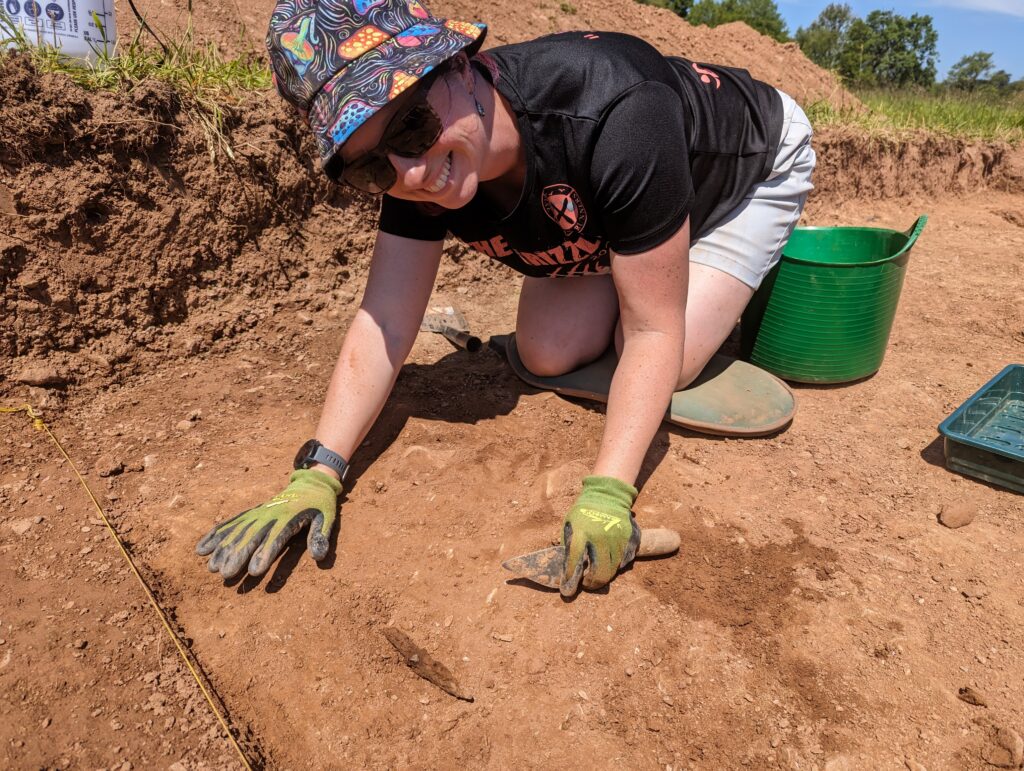
Siobhan discovers an iron knife in a grave cut (DigVentures)
Whether this cemetery is Roman or Early Medieval in date, what’s certain is that we’re seeing evidence of another community in this place – separated by time, but united by a shared use of space.
Life, death, and ritual activity in a landscape of enduring significance
From Bronze Age to Iron Age and into the Roman or early medieval periods, this location was clearly a place of profound importance to successive communities. It’s a powerful reminder that landscapes are not just physical spaces but living repositories of human history and cultural memory.
Thank you to everyone who joined us in-person to help uncover the secrets of the Quantock Hills! The work of the people who now call this place home has been the key in allowing us to connect with the generations who walked these lands before us.