
Capturing the Conversation: Reflecting on Imagining the Future of UK Archaeological Leadership

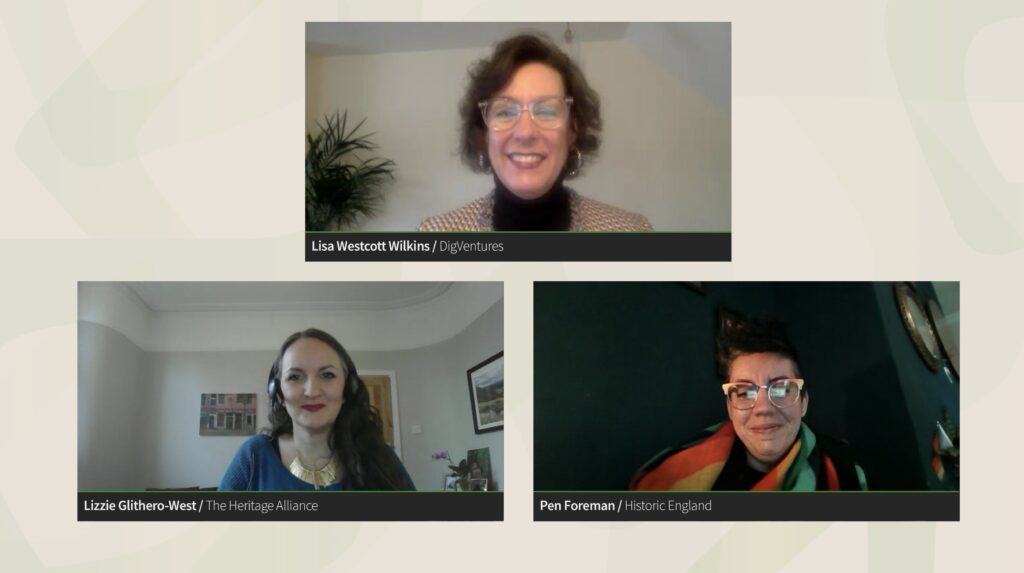
Lisa was joined by panellists Lizzie Glithero-West and Pen Foreman.
I recently had the great pleasure of sharing the digital stage at the DV Trends event Imagining The Future Of UK Archaeological Leadership with two accomplished heritage sector leaders: Dr. Pen Foreman, Senior Inclusive Heritage Advisor at Historic England and Chair of the Chartered Institute for Archaeologists board, and Lizzie Glithero-West, CEO of the Heritage Alliance. Our hour-long discussion explored what makes good leadership and how to cultivate it within archaeology.
With limited time to cover this hot topic (I received plentiful feedback in the weeks leading up to the event!), we focused on sharing transferable advice and steps that could apply across different areas of the sector. Several key themes emerged: the distinction between management and leadership; generosity and reciprocity; openness about failure; creating inclusive teams; how to cope with imposter phobia; and developing future leaders. All three of us highlighted peer-to-peer ‘listening partnerships’ as crucial to our leadership learning. Both Pen and Lizzie drew generously from their personal experiences and training to offer practical advice for leaders at any career stage.
A common misconception is that leadership requires expensive training or advanced degrees. Above all, it’s about deeply caring for the ‘people’ aspect of your role amidst the constant push for technical and financial results. As Pen shared from Robin W. Kimmerer’s ‘Braiding Sweetgrass’: “Leadership is rooted not in power and authority, but in service and wisdom.” Lizzie emphasized emotional intelligence and the importance of ‘putting the ladder down behind us’, noting: “I think it’s okay to be a warm leader… not to think that you have to put up this barrier that means that you’re somehow different to others around you.”
We tackled sector-specific challenges, including the need for better succession planning, more diverse representation, and improved workplace conditions. My view is that archaeology has an opportunity to lead in creating positive workplace cultures. While the conditions and realities of fieldwork present challenges, it’s not the only thing we do. We can address issues like competitive salaries without making it the only priority; we have so much to offer, and can lean in hard to making archaeology one of the best careers in the UK.
Looking ahead, we agreed that leadership development should include formal training, mentorship, and peer support. Pen offered a useful Theory of Change and ‘Vision Board’ model for developing leadership skills, starting with personal reflection about values, goals, and understanding what gives you energy. Lizzie shared the ‘sponge and shield’ analogy for understanding leadership’s dual requirements. At DV, we focus on personal leadership within every role and being intentional about how we show up within teams and externally.
The sector currently lacks both a succession plan and universally adopted shared values. Our conversation concluded with perhaps the biggest leadership question of all: whose job is it to make those succession plans, and to propose and enshrine the values?
I’ll finish with Pen’s mighty answer to the question of how archaeology would look if it had a more embedded culture of leadership, which stands as a manifesto for training our next generation of leaders:
We’ve come a long way in the 40 to 50 years that we’ve had professional archaeology, but it’s happened in such rapid cycles that we haven’t got that embedded culture of leadership.
If it was more embedded, we’d have a sector that was a bit more ambitious; it would set itself higher standards and higher expectations of how we’re treated and viewed by society and at policy level by government.
I think we have a sector that was once louder about its excellence and about the people within it. If we did that on a much bigger level now, we’d be publishing our great work so every press moment wouldn’t be archaeologists stunned or bemused or befuddled – it would be a much different way of talking about the work that we do. I think we’d therefore be a lot less easily missed or spun as being that red tape process, being a hamper to development. We would be seen as more of a core value of society, more relevant to people in their everyday lives.
I think that more than just ambition in the way that we’re viewed, but also in the way that we do things. I think that we’d have more ambition in the way that we do science, and better interconnection between commercial and the academic sectors so that our universities wouldn’t have the struggle that we’re having now with the cutting of archaeology degrees.
I feel that we would have more impact on key sectors that have overtaken us in terms of the way they’re viewed or the way they’re valued by society, like the construction industry and other industries that have a bit more ‘oomph’ when it comes to decision-making or a bit more ‘oomph’ when it comes to the way they’re framed.
I think that with a more embedded culture of leadership, we would value ourselves higher and people would value us higher. It’s demonstrating the value of what we offer to society and to the public.”
DV Trends is back in February! Join us Friday 28 February, 1pm – 2pm, for Archaeology Book Club with Jim Leary, to discuss ‘Footmarks: A Journey Into Our Restless Past’