Five Ice Age mammoths unearthed with Neanderthal stone tools after 200,000 years
Archaeologists reveal the stunning new site behind a new David Attenborough documentary capturing a snapshot of Ice Age Britain.
The remains of at least five Ice Age mammoths, including two adults, two juveniles, and one infant, have been discovered at a quarry near Swindon alongside stone tools made by Neanderthals, in what experts are calling Britain’s most significant Ice Age discovery in recent years.
The excavations, which were led by archaeologists from DigVentures, unearthed astonishingly well-preserved evidence at the site, including delicate beetle wings and fragile freshwater snail shells, as well as stone tools and mammoth bones. Research is ongoing to understand why so many mammoths were found in one place, and whether they were hunted or scavenged by Neanderthals.
Dating evidence has revealed that the site was in use around 210,000 – 220,000 years ago, towards the end of a warm period known as MIS7 when Britain was still occupied by Neanderthals, before they were forced away by the increasingly cold temperatures that followed.
The discoveries are explored in a major new BBC documentary ‘Attenborough and the Mammoth Graveyard’, with Sir David Attenborough and evolutionary biologist Professor Ben Garrod joining DigVentures on site to film the excavations.
With archaeological sites from this period rarely so well preserved, these new discoveries will help archaeologists, palaeontologists, and palaeoenvironmental scientists address big questions about Neanderthals, mammoths, and the impact of a rapidly changing climate on life in Ice Age Britain.
DigVentures began investigating the site after two passionate fossil-hunters, Sally and Neville Hollingworth, spotted a Neanderthal hand axe along with an impressive number of mammoth remains at a Swindon quarry.
Excavations, undertaken across two seasons in 2019 and 2021, revealed further evidence of Neanderthal activity on the site, including small flint tools called ‘scrapers’, which would have been used for cleaning fresh hides.
The team also recovered bones including tusks, leg bones, ribs and vertebrae belonging to a species of Steppe mammoth. Smaller and less hairy than their more well-known descendants, the Woolly mammoth, early Steppe mammoths were among the largest with some standing up to 4m tall at the shoulder. The bones recovered by the excavation are quite small, displaying evidence of the species’ decreasing size as temperatures grew colder.
Lisa Westcott Wilkins, Co-founder, DigVentures said: “Finding mammoth bones is always extraordinary, but finding ones that are so old and well preserved, and in such close proximity to Neanderthal stone tools is exceptional. Words can’t quite capture the thrill of seeing a mammoth tusk still in the ground, or the feeling of standing in the middle of a site that has the potential to change how we see our closest human relatives and the Ice Age megafauna they shared their world with”
“Turning such an exciting discovery into a BBC documentary has made this a once in a lifetime experience, especially working with Sir David Attenborough. It has given us the chance to see the site through his eyes, and to reveal the extraordinary science that goes into each step of discovery” she added.
“There is still so much more to be uncovered here. The collaboration between scientists, landowners, and enthusiasts has been crucial, and we are already looking at how to continue the investigations and are exploring different ways that members of the public might be able to be part of it” she concluded.
Duncan Wilson, Chief Executive, Historic England, said: “This represents one of Britain’s most significant Ice Age discoveries in recent years. We have provided over £100,000 to fund the excavations, which have resulted in the discovery of mammoth skeletons, stone age tools, and have provided valuable further insight into Britain’s Ice Age environment. The findings have enormous value for understanding the human occupation of Britain, and the delicate environmental evidence recovered will also help us understand it in the context of past climate change. Through these finds and the research that will follow, we look forward to further light being shed on life in Britain 200,000 years ago.”
Sally Hollingworth said “We were originally hoping to find marine fossils, and finding something so significant instead has been a real thrill. Even better than that is seeing it turn into a major archaeological excavation led by DigVentures, and a BBC documentary presented by David Attenborough. We couldn’t be more pleased that something we’ve discovered will be learned from and enjoyed by so many people”
Peter Andrew, Group Director for Hills Quarry Products said “As the landowners, we are delighted to see so much interest in the discoveries from this site and to have facilitated such great research. We have a long-standing relationship with the Hollingworths and provided substantial resources to enable the excavations to take place, and will continue to support future investigations so that more discoveries can be made”
The unusually high preservation of the site means that the team has also been able to recover crucial environmental and dating evidence. Some of the bones are now being examined for evidence of butchery, and further work is being planned at the site.
The work was funded by Historic England and supported by Dr Keith Wilkinson of ARCA at the University of Winchester, the site’s landowners Hills Group Quarry Products, as well as a wider specialist team from several UK research institutions.
For more information about the dig, related events, and how to register your interest in being part of future investigations at the site, visit digventures.com
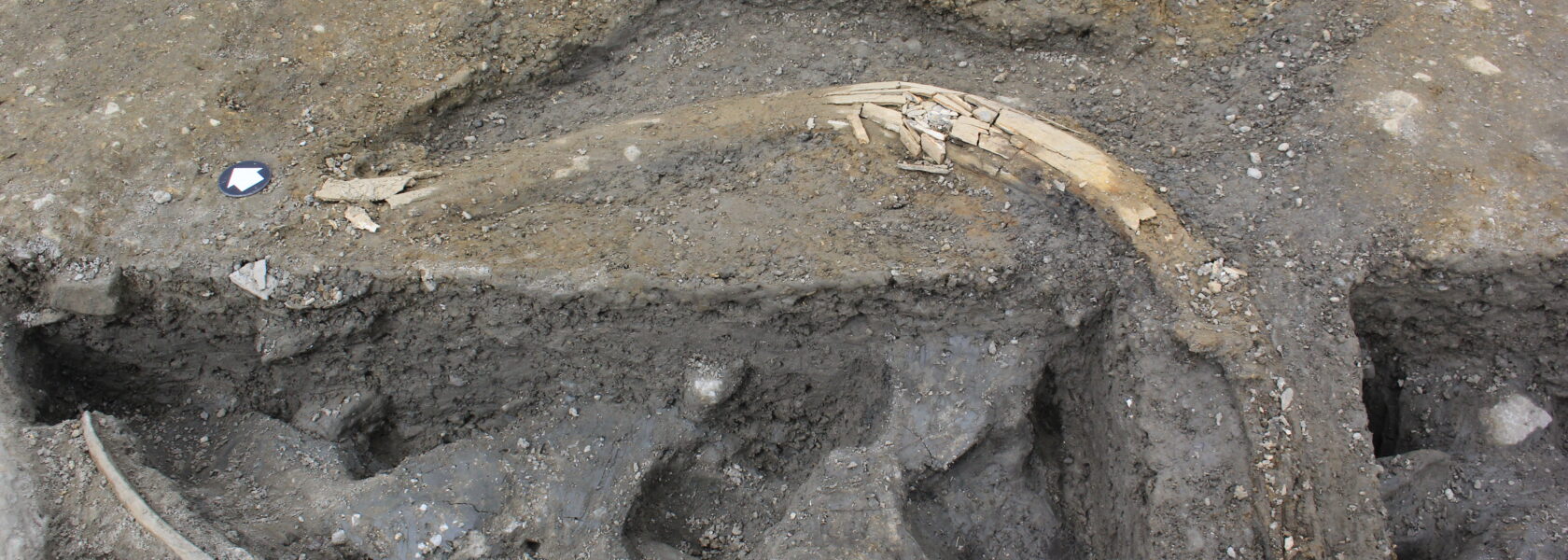
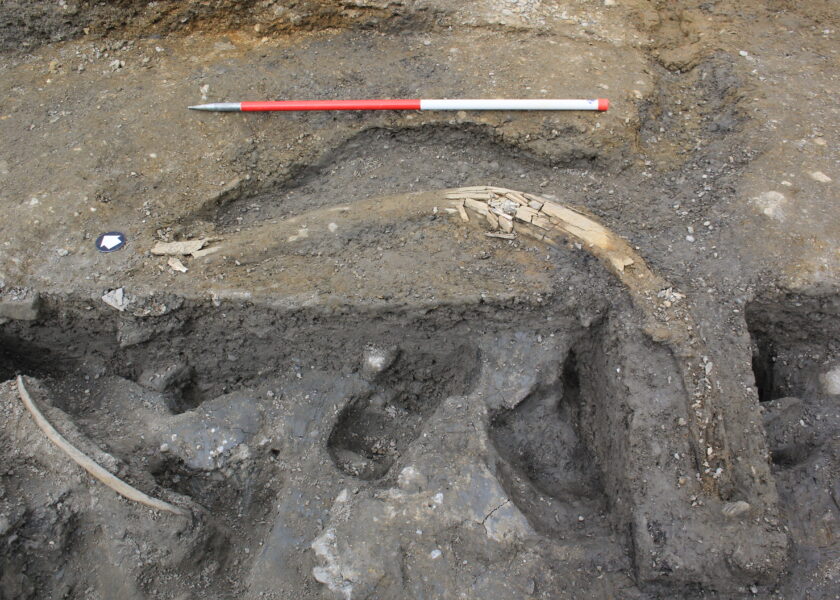
Archaeologists carefully exposes a mammoth tusk in the sediment c. DigVentures
A mammoth tusk is exposed in the sediment c. DigVentures
Archaeologists lift the mammoth tusk to safety c. DigVentures
The mammoth tusk is conserved in the lab to prevent it from deteriorating
Flint hand axe made by a Neanderthal c. DigVentures & Sally Hollingworth
Mammoth tooth c. DigVentures
Hundreds of mammoth bones have been found, including tusks, teeth, leg bones, and vertebrae, as well as stone tools c. DigVentures
Samples from the different layers of gravel and sediment revealed delicate environmental remains, including freshwater snails and beetle elytra c. DigVentures
Images
Photos from the excavations can be downloaded here:
https://www.dropbox.com/sh/ve8ctqgqetl5n3y/AADOar95akMvtpeh30Wg9JeEa?dl=0
Please credit all images to DigVentures.
Media enquiries
To request additional comments, images, interviews, or information from the research team, please contact:
Maiya Pina-Dacier
Notes for Editors
- Archaeological excavations were carried out in 2019 and 2020, after dedicated fossil hunters Sally and Neville Hollingworth were given permission to search a quarry near Swindon and spotted the remains in 2017
- ‘Attenborough and the Mammoth Graveyard’ is due to broadcast in late December 2021. It was made by Windfall Films. It was commissioned by Patrick Holland, Director, Factual, Arts and Classical Music Television and Jack Bootle, Head of Commissioning, Science and Natural History for the BBC. The Producer is Jamie Lochhead and the Executive Producer is David Dugan.
- DigVentures is planning further research at the site, and will also be exploring different ways that members of the public can participate in upcoming investigations
- Researchers believe that the site dates towards the end of a climatic period known as MIS 7, which runs from approximately 260,000-180,000 years ago. Temperatures began to plummet from around 200,000 years ago forcing Neanderthals away, with no evidence of human occupation in Britain between 180,000 – 60,000 years ago.
- This timeframe is critical in Europe as it records the emergence of Neanderthals. Sites from this period are rare, and much of our current understanding of Neanderthal stone tool technology is based on antiquarian collections. New discoveries hold significant value for understanding human occupation in Britain and the development of Neanderthal stone tool technologies
- Excavations also recovered the remains of Steppe bison and brown bears, as well as seeds, pollen and plant fossils, which showed that extinct types of trees and beetles lived around the site as well as more familiar species, like hornbeam. The samples also included dung beetles, who co-evolved with Ice Age megafauna and whose droppings they used for food and shelter.
- The site also gives scientists studying the evolution of mammoths the opportunity to study population changes in this important transitional period leading to the emergence of the quintessential Ice Age animal, the Woolly mammoth
About DigVentures
DigVentures continues to lead the ‘mammoth graveyard’ research team. We are a team of archaeologists who aim to increase public participation in archaeology: from Roman settlements and Iron Age hillforts, to medieval castles and miners’ cottages, we organise archaeological digs and research projects that adults and children take part in, online and on site. We are registered with the Chartered Institute for Archaeologists.
We are already planning further research at the ‘mammoth graveyard’ and are exploring different ways that members of the public can participate in upcoming investigations. We will also be launching a project called PalaeoPixels enabling teenagers to work with the delicate material from the site. Find us on social media @thedigventurers. For more information about the dig and opportunities to join us on site, visit digventures.com
About Historic England
We are Historic England the public body that helps people care for, enjoy and celebrate England’s spectacular historic environment, from beaches and battlefields to parks and pie shops. We protect, champion and save the places that define who we are and where we’ve come from as a nation. We care passionately about the stories they tell, the ideas they represent and the people who live, work and play among them. Working with communities and specialists we share our passion, knowledge and skills to inspire interest, care and conservation, so everyone can keep enjoying and looking after the history that surrounds us all. Follow us on social media @HistoricEngland
About Sally and Neville Hollingworth
Sally and Neville Hollingworth are passionate fossil hunters, spending most of their time searching the countryside and coast for evidence of past life. Over the years they have built up excellent relationships with local landowners and quarry operators. They have made many exciting discoveries over the last few years. Neville is a professional geologist with a PhD in palaeontology and Sally is an experienced fieldworker and fossil preparator.
About Hills Quarry Products
Hills Quarry Products specialises in the production and supply of quarry products and ready-mixed concrete to the construction and agricultural sectors. It is a dynamic regional business which, while centred on Wiltshire, has stretched its boundaries into neighbouring areas to become one of the region’s largest suppliers. Hills Quarry Products is a wholly owned subsidiary of The Hills Group Limited, a privately owned family company established in 1900. For more information, visit hills-quarry.co.uk