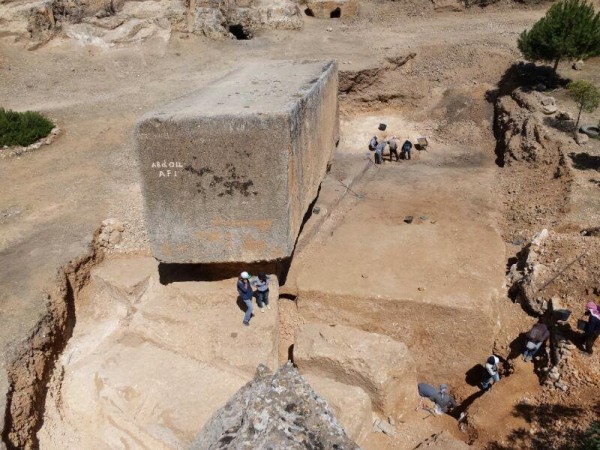

See that really massive stone block? No, not that one. Look to the right. There, that’s the one. German archaeologists working at the Baalbek site in Lebanon have uncovered the biggest stone block ever carved by human hands in antiquity.
Known as Heliopolis by the Romans, Baalbek was home to one of the grandest sanctuaries in the empire, where similar stone blocks, some measuring up to 20 meters long and 4 x 4 meters wide, make up what remains of the podium of the massive Temple of Jupiter.
The fully exposed block on the left was found by a team from the German Archaeological Institute in Baalbek’s stone quarry and is known as “Hajjar al-Hibla” or The Stone of the Pregnant Woman. It weighs about 1,000 tons and is thought to have been carved about 2,000 years ago, when Baalbek was a Roman colony and construction on several temples had begun.
But then, to their amazement, the archaeologists found an ever bigger stone, just off to the side and underneath it. Estimated to weigh an incredible 1,650 tons, the block is 19.6 meters long, 6 meters wide and at least 5.5 meters high.
“The level of smoothness indicates the block was meant to be transported and used without being cut,” the German Archaeological Institute said in a statement. “This is the biggest boulder known from antiquity,” it added.
That knocks the unfinished obelisk found in an ancient Egyptian quarry in Aswan off its pedestal. But the biggest question is, why was the stone left in the quarry? And how had its builders intended to transport it? The Hajjar al-Hibla block nearby might provide some clues: it was probably left in the quarry because the stone quality at one edge proved to be poor, and would probably have cracked during transportation, the archaeologists said.
By comparison, blocks from Stonehenge weigh in at about 40 tons. As excavations continue, archaeologists will try to find out whether the bigger block suffered the same problem. Or maybe, like some of the others, it was simply supposed to be 20 meters long. Someone probably got quite a scolding for that mistake.